
Stormwater management involves managing both the quantity and quality of surface runoff. An appreciation of a site’s Particle Size Distribution (PSD) is crucial for effective stormwater quality management. The PSD influences sediment transport, settling rates and determines the effectiveness of treatment systems in terms of capturing, retaining and so permanently removing contaminants found in stormwater runoff sediments.
What sizes are sediment particles?
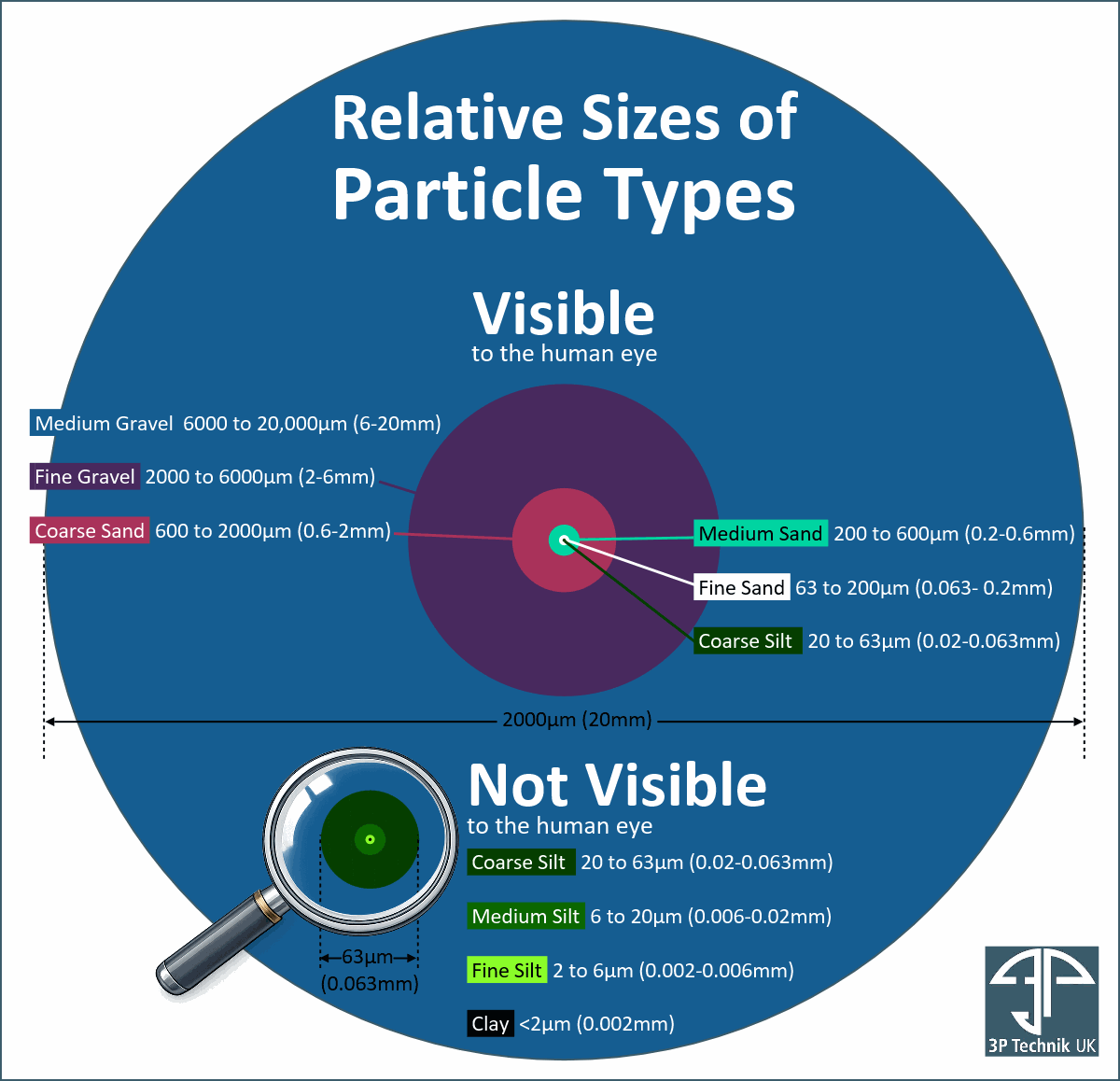
Infographic: Relative sizes of particle types found in stormwater run off
In stormwater management particle sizes are generally categorised as:
| Particle Type | Particle Size (microns µm) |
|---|---|
| Clay | <2 |
| Fine Silt | 2-6 |
| Medium Silt | 6-20 |
| Coarse Silt | 20-63 |
| Fine Sand | 63-200 |
| Medium Sand | 200-600 |
| Coarse Sand | 600-2,000 |
| Fine Gravel | 2,000-6,000 |
| Medium Gravel | 6,000-20,000 |
The sediments within a water sample are often called the Total Suspended Solids (TSS).
What is Particle Size Distribution?
Particle Size Distribution (PSD) describes the sizes of the particles found within a water sample. PSD is typically expressed using percentile values from either weight or the number of each particle size present in the sample. It is measured in microns or micrometres (µm) using standard sieve analysis to a known procedure. This assessment is often specified within test protocols set by a regulator (such as NJDEP or the DIBt).
The percentile values for example are expressed as D10, D50 and D90, which represent the particle sizes where 10%, 50% and 90% of the particles fall under that size, are “finer than”. D50, which represents the median particle size within that specific sample. For example, a water sample with TSS having a D50 of 80µm, means that half of the particles are smaller than 80µm and half are larger.
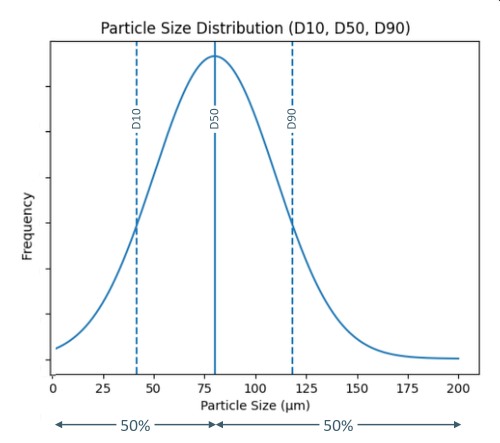
Example Bell Curve of Particle Size Distribution D50 at 80µm
A bell-shaped curve or histogram is representative of a PSD, which clearly shows the distribution of particles around (above and below) the most frequent particle size- D50.
How to measure PSD
Field measured PSD can be highly variable, so several techniques are used to determine it, depending on particle size and material characteristics:
- Sedimentation techniques: measures the settling velocity of particles in a liquid, based on Stoke’s Law which relates to a particle’s size, shape and density to settling speed. Typically used for larger, denser particles.
- Laser diffraction: a precise and rapid method for fine particles, where a laser beam passes through the sample, resulting in larger particles scattering the light at smaller angles and smaller particles scatter the light at larger angles. The overall diffraction pattern calculates PSD.
- Sieve analysis: suitable for coarser particles, where sediments are passed through a series of mesh layers decreasing in sizes, and the retained weight is measured.
- Dynamic light scattering (DLS): Used for nanometre-sized particles. The Brownian motion of particles is measured to calculate their hydrodynamic diameter.
- Image analysis: used for particles greater that 10µm with various shapes and sizes. Image processing software determines dimensions-diameter, length and width for each particle to generate a size distribution.
The most appropriate method to measure PSD depends on the particle size range and material properties. To obtain reliable PSD data for any one site, representative stormwater samples should be collected during multiple storm events to capture variability under different flow conditions for a specific site. Land use, vegetation, wind speed, traffic density, traffic type and street sweeping can all influence the PSD of an individual storm (Dierschke et al., 2021).
It is also necessary to design or know the range of TSS over which the PSD is to be stated. Without stating the range, it is not possible to compare between devices. The best known and widely respected Test Protocols use a PSD that is predominantly based on 0 – 200 microns. (see DiBT, NJDEP, BW, SQIDEP). Particles above 200 microns are usually of less interest to stormwater treatment designs.
Sediment Contamination: Sources, Characteristics and Consequences
Anthropogenic activities such as industrialisation, agriculture and urbanisation lead to the introduction of chemical contaminants into water bodies. Contaminants include heavy metals (e.g.Pb, Zn, Cu, Hg), organic compounds (e.g. chlorinated pesticides), phosphorus, hydrophobic organics and hydrocarbons. Concentrations of these toxic chemicals increase with more intense traffic locations (Dierkes et al., 2014). Such contaminants can persist in sediment for years posing risks to aquatic environments, human health and environmental quality including soils and groundwater supplies (Dierkes et al., 2002). They may accumulate in soils (rain gardens etc), won’t necessarily degrade and may bio-accumulate.
Stormwater can contain significant concentrations of heavy metal elements, derived from traffic and vehicle emissions and releases, degradation of pavements and atmospheric deposition (Dierkes et al., 1999). Heavy metals in stormwater can risk harm directly through their direct toxicity leading to declines in fish populations or through bioaccumulation over time in aquatic ecosystems. This bioaccumulation can move up food webs to higher trophic level predators, which could potentially reach human consumption. In humans, even at low concentrations it can lead to serious illnesses and health problems such as kidney or liver damage, brain damage and an increased risk of cancer. Low concentrations of heavy metals can promote growth in algae and aquatic plants. However, if the concentrations of heavy metals exceed a certain level, processes such as photosynthesis can be restricted which inhibits the growth of algae (Xiao et al., 2023). Available oxygen levels in the aquatic environment decreases which contributes to the degradation of aquatic habitats.
Aquatic life is also at risk if hydrocarbons are present in stormwater runoff. These can cause cancer, mutations, deformities and reproductive issues in aquatic organisms as well as bioaccumulating in the environment, subsequently working their way up the food chain. They potentially could bioaccumulate up through trophic levels, potentially entering human food webs depending on the organisms present and how contaminated the water body becomes. Hydrocarbons can be toxic to the human nervous system and cause cancer through carcinogenic compounds.
Critically, contaminants are not evenly distributed across different particles sizes in a sample. Sediment removal efficiency depends on particle size, it being harder to remove finer particles. Pollutant contamination in stormwater is highest in finer solids (<64µm) due to the larger surface area-to-volume ratio when compared with coarser sediments. Fine solids remain suspended in water for long periods of time, making them harder to remove. Coarse solids settle quickly in sedimentation systems and therefore are easier to remove. This is an unfortunate reality, as the greatest risk of contamination comes from the hardest to remove finer solids.
Why PSD matters in stormwater design
Determines treatment selection
Different stormwater treatment systems target different particle size ranges, as settling velocity varies with particle size.
- Larger particles settle quickly and can be removed through sedimentation basins or hydrodynamic separators that are designed with the required retention time or flow rate
- Smaller particles that resist settling or have a lower settling velocity could use filtration systems to remove the pollutant carrying sediments effectively
- Ultra-fine particulate matter may even require advanced treatment technologies such as membrane filtration or biofiltration systems.
If the PSD is known or is typically known, engineers can match the appropriate treatment system to the site’s specific pollutant load. For example, if a treatment system is chosen that relies on sedimentation, whether settling will be effective in practice or if filtration would also be required. This ensures the system is efficient and cost effective throughout its design life. There is perhaps little point installing a device or a system to settle a TSS with a PSD of 110 microns and above (i.e. only the coarser fraction tested in the certifications processes) if it is known that the primary issue from a busy road is the heavy metal loading bound to particles finer than 64 microns (PM64).
PSD Influences pollutant removal efficiency
Most stormwater pollutants, such as heavy metals and hydrocarbons are typically particle bound. Fine particles adsorb a greater proportion of pollutants compared to coarse particles. These fine particles are harder to remove, often bypassing conventional sedimentation systems and require advanced filtration to remove.
Best Management Practices (BMPs) refers to the methods and devices that are used to manage stormwater runoff. BMPs are sized based on removing a percentage of TSS. Removing 80% of TSS (0-200 µm) is what regulatory authorities are typically content with as that is the widely adopted standard for best water quality from contaminated areas. Typically, it is common sense that 50% removal of TSS (0-200µm) is required within the first step of a Treatment Train. But TSS removal does not directly correlate with pollutant removal; therefore, with a more accurate knowledge of PSD, a BMP can be designed to capture the particles that are at most concern- these being fine particles as they have the ability to carry the most contaminants that need to be removed.
Without understanding specific PSD, pollutant capture may be overestimated, leading to an overall lower pollutant removal efficiency. This potentially might make the system non-compliant with water quality standards.
Further research into PSD characteristics will improve the accuracy of pollutant removal models and therefore a more overall effective system.
Affects hydraulic performance and maintenance
The PSD influences clogging rates for filters, rates of sediment accumulation in retention basins and therefore the maintenance frequency for the treatment systems. If a manufactured filter device states that it will “never clog”, it is most likely to be ineffective in removing sediments and contaminants! The TSS retained must be held somewhere below or within the filter. Uncertified devices or devices not tested for re-mobilisation can also be a problem. Many such devices are still widely sold in the UK market especially.
Systems exposed to finer PSDs may experience faster filter clogging that require more frequent replacement than expected. By knowing PSD data at the design stage, a system can be made to optimise flow rates, maintenance intervals and therefore its design life expectancy.
Over or under-engineering the size of the treatment system needed will either increase the necessary cost of the systems (installation and maintenance) or the system itself will fail to meet performance targets. If the size of the treatment system installed is based off PSD, optimal performance is ensured for the site. Many UK sites have under specified devices, that just allow retained sediments to periodically wash out, which is why they never need maintenance.
Enhances model accuracy and regulatory compliance
Stormwater models rely on PSD data to simulate sediment transport and pollutant behaviour more accurately. Therefore, having accurate PSD data can help create efficient models with more reliable treatment systems.
Outdated assumptions like the single, nationwide benchmark created by NURP (National Urban Runoff Program), can result in over- or under-performing systems.
The CIRIA SuDS Manual (C753) recognises the importance of site-specific PSD data when assessing TSS removal efficiency as some systems only remove larger particles, but higher concentrations of pollutants are found adsorbed to smaller particles (<64µm).
Being compliant with standards set out in:
- SuDS Standards (S3 Wales, S4 England)
- EU Water Framework Directive (WFD)
requires that treatment systems effectively remove contaminants before either reusing the water on site or discharging treated waters back to the water environment.
Wales SuDS Standards are statutory, therefore a legal requirement that treatment of water must take place, so that surface and groundwater contamination is prevented. However, England’s standards remain just guidance and not legally enforceable but still advise treatment from high-risk land uses. The WFD uses particle size data in sediments to classify and monitor water bodies to establish ecological aquatic status.
Supports site-specific design optimisation
No two sites share the same characteristics- land use, road materials, traffic, soil type, soil condition and climate all influence the PSD found in stormwater runoff. Analysing PSD for specific sites allows for:
- An accurate prediction of sediment rates
- Optimised sizing and configuration of treatment systems, while reducing capital and lifecycle costs
- Long-term reliability for the stormwater treatment
This allows a system to be tailored to specific conditions and not general assumptions, leading to more sustainable and resilient designs for specific storm events in that region.
Conclusion
Understanding PSD is the foundation of effective stormwater management design and is crucial in the process of selecting the most appropriate treatment system for that specific site. This will improve pollutant removal efficiency and ensure sustainable stormwater management aligned with SuDS standards and WFD principles.
In reality, this is likely only to be done for the more contaminated sites, and the Treatment Train approach in the UK provides some factor of safety for any mis-assessment of PSD. Nonetheless, systemically failing to address the quantity of PM64 in a stormwater that is to be treated is likely to lead to disappointing water quality outcomes on new UK SUDS projects.
Author: Alys Bradshaw, 3P Technik UK Ltd.
Treatment Solutions for TSS in Stormwater Runoff
Understanding the PSD and the true nature of pollutant loading in Stormwater Runoff is only part of the equation, choosing the right solution is what ultimately delivers results. Our industry-leading treatment systems are specifically engineered to provide proven, reliable TSS removal in stormwater applications, ensuring performance you can trust both now and into the future.
3P Technik’s technical team can provide project-specific advice and support. Please contact us to discuss your requirements.
References
- Bettersize. 2023. What is D50? https://www.bettersizeinstruments.com/learn/bettersize-wiki/what-is-d50/
- Charters, F., Cochrane, T. and O’Sullivan, A.D. 2015. Particle size distribution variance in untreated urban runoff and its implications on treatment selection. https://www.researchgate.net/publication/281399820_Particle_Size_Distribution_Variance_in_Untreated_Urban_Runoff_and_its_Implication_on_Treatment_Selection
- CIWEM. Highway runoff pollution: the toxic cocktail no-one wants to tackle. https://www.ciwem.org/the-environment/highway-runoff-pollution-the-toxic-cocktail-no-one-wants-to-tackle
- DataStream. Organic pollutants- hydrocarbons. https://datastream.org/en-ca/guidebook/hydrocarbons
- Dierkes, C., Gobel, P., Coldeway, W.G., Fleischanderl, T., Mothersbaugh, J.I., Dierackley, L., Mothersbaugh, J.E. and Stark, J. 2014. Passive filter- sustainable BMP for permanent stormwater treatment of heavy metals, nutrients, hydrocarbons and sediment. https://www.researchgate.net/publication/237466968_Passive_Filter_-_Sustainable_BMP_for_Permanent_Stormwater_Treatment_of_Heavy_Metals_Nutrients_Hydrocarbons_and_Sediment
- Dierkes, C., Holte, A. and Geiger, W.F. 1999. Heavy metal retention within a porous pavement structure. https://www.researchgate.net/publication/237544897_HEAVY_METAL_RETENTION_WITHIN_A_POROUS_PAVEMENT_STRUCTURE
- Dierkes, C., Kuhlmann, L., Kandasamy, J. and Angelis, G. 2002. Pollution retention capability and maintenance of permeable pavements. https://ascelibrary.org/doi/10.1061/40644%282002%2940
- Dierschke, M., Welker, A. and Dierkes, C. 2021. Selection of a reference material for the testing of decentralised stormwater treatment facilities. https://hal.science/hal-03296310/document
- Evergreen StormH2O. 2023. Stormwater particle size distribution and implications for BMP effectiveness. https://www.ezview.wa.gov/Portals/_1962/Documents/SAM/D3.5%20Final%20White%20Paper.pdf
- Gelhardt, L., Kush, B., Dittmer, U. and Welker, A. 2021. Granulometric distribution of metals in road-deposited sediments by using different sieving methods. https://www.sciencedirect.com/science/article/pii/S266676572100065X
- Kominkova, D. and Nabelkova, J. Effect of urban drainage on bioavailability of heavy metal in recipient. https://pubmed.ncbi.nlm.nih.gov/18025730/
- Lacy, S. The fate of heavy metals in highway stormwater runoff. https://kuscholarworks.ku.edu/server/api/core/bitstreams/525e2372-7834-45bf-92b7-8cbbcc48e967/content#:~:text=The%20usual%20wear%20of%20automobiles,matter%2C%20clay%20and%20metal%20oxides.
- Lees, A. 2022. What is particle size distribution in soils? https://www.tensar.co.uk/resources/articles/what-is-particle-size-distribution-in-soils
- Microtrac. Analysis of particle size distribution. https://www.microtrac.com/knowledge/particle-size-distribution/
- Pochodyla-Ducka, E., Glinska-Lewczuk, K. and Jaszczak, A. 2023. Changes in stormwater quality and heavy metals content along the rainfall-runoff process in an urban catchment. https://www.mdpi.com/2073-4441/15/19/3505
- Stormceptor. PSD particle size matters. https://www.imbriumsystems.com/Portals/0/documents/sc/technical_docs/Particle%20Size%20Distribution.pdf
- Weiss, P.T., Erickson, A.J. and Hettler, E. 2010. The importance of particle size distribution on the performance of sedimentation practices. https://stormwaterbook.safl.umn.edu/other-resources/appendices/importance-particle-size-distribution-performance-sedimentation
- Winston, R.J., Witter, J.D. and Tirpak, R.A. 2023. Measuring sediment loads and particle size distribution in road runoff: implications for sediment removal by stormwater control measures. https://www.sciencedirect.com/science/article/abs/pii/S004896972304696X
- Xiao, X., Li, W., Jin, M., Zhang, L., Qin, L. And Geng, W. 2023. Responses and tolerance mechanisms of microalgae to heavy metal stress: A review. https://www.sciencedirect.com/science/article/abs/pii/S0141113622002501