
What are Total Suspended Solids?
In stormwater runoff, Total Suspended Solids (TSS) refers to undissolved solid particles larger than 0.45µm. Anything smaller is considered a dissolved substance. Pollutants can bind to or become trapped within these solid particles, making TSS a highly effective contaminant transport mechanism from surface road runoff into receiving water bodies.
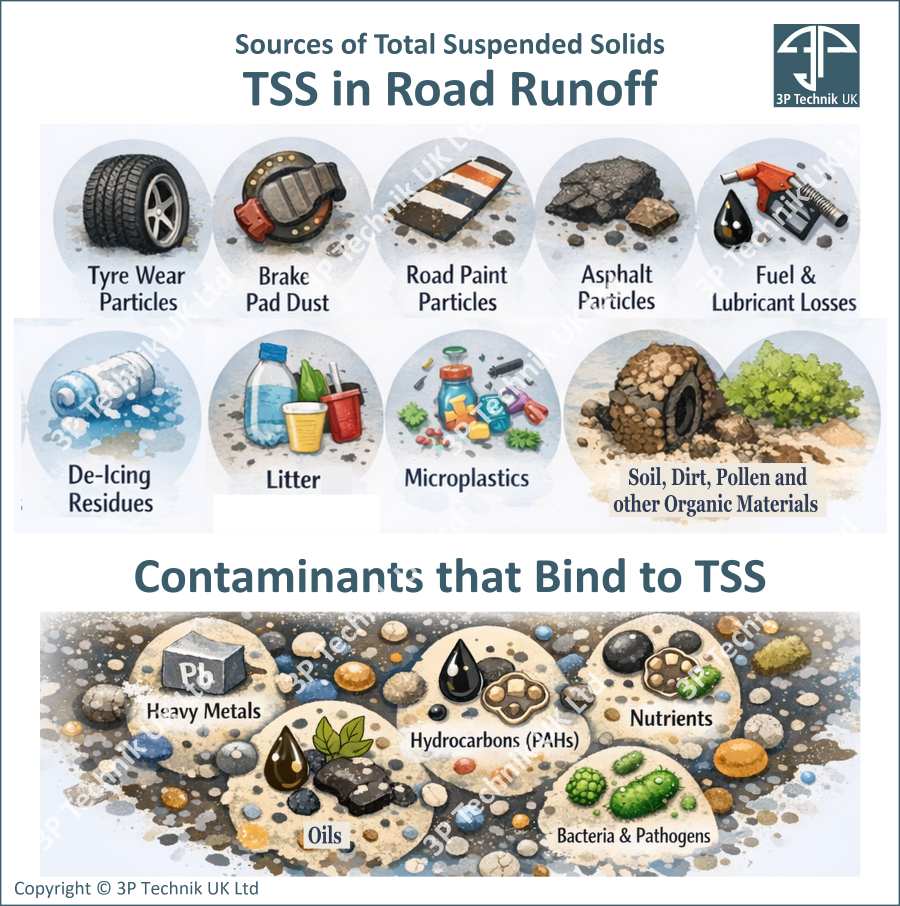
Infographhic: Sources of Total Suspended Solids (TSS) in road run off and contaminants that bind to them.
In road runoff, TSS includes a mixture of natural and synthetic contaminants, such as:
- Tyre wear particles
- Brake pad dust
- Road paint particles
- Asphalt particles
- Fuel and lubricant losses
- De-icing residues
- Litter and microplastics
- Soil or waste stuck to tyres
TSS particles have large surface areas, meaning they provide strong adsorptive properties that can readily bind contaminants such as heavy metals, hydrocarbons (PAHs), oils, nutrients from organic matter, and microorganisms like pathogens and bacteria.
Why does contaminated TSS matters?
While TSS itself is a pollutant, the contaminants they ‘carry’ are of more concern. When contaminated TSS enters receiving water bodies such as lakes, rivers and oceans via stormwater drainage, harmful effects on aquatic organisms and the aquatic environment may occur. Soils too can accumulate such pollution.
- Rise in toxicity levels
The attached pollutants can accumulate in both sediments and organisms in aquatic environments. This bioaccumulation of toxic chemicals can affect the development, growth and reproduction of living aquatic organisms while degrading the overall ecosystem’s health. - Reduced water clarity
The increase in a water body’s turbidity can make the water appear as cloudy. This prevents photosynthesis from taking place in plants and algae, lowering oxygen levels and affecting the survival of aquatic life, possibly destroying the entirety of the aquatic food web. - Sedimentation and habitat alteration
The accumulation of particles at the bottom of water bodies through the process of sedimentation can literally clog habitats and alter topography at the bed of the water. - Impact on stormwater treatment systems
High loads of TSS can clog sediment basins, filters, pipes and other stormwater treatment devices. Overall efficiency of the treatment device to remove unwanted contaminants will decrease, meaning more frequent maintenance is required. - Human impacts
Contaminated water bodies may alter the required water treatment methods to meet safe drinking water guidelines. Recreational water bodies such as lakes could become toxic and generate health consequences for humans.
Why PAHs Associated with TSS Matter
Polycyclic Aromatic Hydrocarbons (PAHs) are an important group of contaminants commonly found in road runoff and are strongly associated with Total Suspended Solids (TSS), particularly fine sediment fractions such as silts and clays. PAHs originate from incomplete combustion processes and are commonly introduced into runoff through vehicle exhaust emissions, tyre and brake wear, oil leakages and other traffic-related activities.
From a stormwater treatment perspective, PAHs are significant because many are environmentally persistent, bioaccumulative and potentially carcinogenic. Lower molecular weight PAHs (containing two to three aromatic rings) tend to show greater acute toxicity, while higher molecular weight PAHs (containing four to seven aromatic rings) are generally more persistent within the environment and are more strongly associated with carcinogenic and mutagenic effects.
Once deposited onto road surfaces, PAHs become mobilised during rainfall events and are transported within stormwater runoff. Most PAHs are not freely dissolved in water but are instead particulate-bound contaminants that adsorb onto suspended solids, particularly the finer sediment fractions. This is important because fine suspended solids are typically the most difficult particles to remove within stormwater treatment systems.
Although PAHs are hydrophobic, they are also lipophilic, meaning they readily associate with oils, fats and organic matter. This behaviour increases their tendency to bioaccumulate within aquatic and terrestrial organisms once discharged into receiving waters. Higher molecular weight PAHs are especially resistant to degradation and can persist within sediments, drainage infrastructure and aquatic environments for long periods.
The environmental and human health implications associated with PAH contamination are therefore closely linked to the transport of fine suspended solids in runoff. Once PAH-contaminated sediments enter rivers, lakes, groundwater or coastal waters, they may contribute to long-term water quality degradation and ecological impacts, including toxicity to aquatic organisms and bioaccumulation within food chains.
This relationship between PAHs and fine TSS highlights why particle size distribution is often as important as total suspended solids concentration when assessing stormwater treatment performance. Treatment systems designed only for coarse sediment capture may remove visible solids effectively whilst allowing a significant proportion of the finest and most contaminated particles to bypass the system.
For a more detailed discussion on the relationship between PAHs and particle size distribution in stormwater runoff, see our article: Stormwater Treatment of PAHs: Why Particle Size Distribution Matters for SuDS Design.
Mitigation practices
The 3P Technik HydroSystem is a multi-process stormwater treatment device. The four treatment stages of sedimentation, filtration, adsorption and ion exchange ensure the output of clean, safe water. This multi process system is specifically designed for use in high trafficked areas, where TSS particles are assumed to be high, and with high concentrations of contaminants attached to them. With the removal of these toxic TSS particles, the potential harmful effects to aquatic life, environments and human health will be significantly reduced. The typical UK Mitigation Index for these filters is 0.8, 0.9, 0.9.
Author: Alys Bradshaw, 3P Technik UK Ltd.
Treatment Solutions for TSS in Stormwater and Road Runoff
Our industry-leading treatment systems are specifically engineered to provide proven, reliable TSS removal in stormwater applications, ensuring performance you can trust both now and into the future.
3P Technik’s technical team can provide project-specific advice and support. Please contact us to discuss your requirements.
References
- Fondriest Environmental Learning Center. Turbidity, Total Suspended Solids and Water Clarity. https://www.fondriest.com/environmental-measurements/parameters/water-quality/turbidity-total-suspended-solids-water-clarity/
- Hills, M. 2016. All stormwater particles are not the same. Part 1: particle size and composition. https://www.conteches.com/knowledge-center/learn/the-stormwater-blog/all-stormwater-particles-are-not-the-same-part-1-particle-size-and-composition/
- Muller, A., Osterlund, H., Marsalek, J. and Viklander, M. 2020. The pollution conveyed by urban runoff: A review of sources. https://www.sciencedirect.com/science/article/pii/S0048969719361212
- Ogbonna, C., Emmanuel, A., Nwachi, C. and Okeoma, I. 2023. Total suspended solids loading of stormwater from different land use areas in an urban watershed. https://www.researchgate.net/publication/377276939_Total_suspended_solids_loading_of_stormwater_from_different_land_use_areas_in_an_urban_watershed
- Popick, H., Brinkmann, M. and McPhedran, K. 2022. Assessment of stormwater discharge contamination and toxicity for a cold-climate urban landscape. https://link.springer.com/article/10.1186/s12302-022-00619-x
- Soto, I.L., Sanchez, Y.C. and Raya, A. 2024. Water quality polluted by total suspended solids classified within an artificial neural network approach. https://iwaponline.com/wqrj/article/60/1/214/106336/Water-quality-polluted-by-total-suspended-solids
- Spence, K., Gilbert, I. and Robson, M. 2023. Stormwater suspended solids and pollutant concentrations in an urban stream. https://shura.shu.ac.uk/32199/9/Spence-StormwaterSuspendedSolids%28VoR%29.pdf
Sustainability Directory. 2025. Total Suspended Solids. https://lifestyle.sustainability-directory.com/term/total-suspended-solids/ - Winston, R.J., Witter, J.D. and Tirpak, R.A. 2023. Measuring sediment loads and particle size distribution in road runoff: implications for sediment removal by stormwater control measures. https://www.sciencedirect.com/science/article/abs/pii/S004896972304696X#:~:text=As%20there%20is%20limited%20data,in%20the%20studied%20stormwater%20system
- Yan, H., Vosswinkel, N., Ebbert, S., Kouyi, G.L., Mohn, R., Uhl, M. and Bertrand-Krajewski, J.L. 2020. Numerical investigation of particles’ transport, deposition and resuspension under unsteady conditions in constructed stormwater ponds. https://link.springer.com/article/10.1186/s12302-020-00349-y#Sec13
- Zhao, H., Ma, Y., Fang, J., Hu, L. and Li, X. 2022. Particle size distribution and total suspended solid concentrations in urban surface runoff. https://www.sciencedirect.com/science/article/abs/pii/S0048969721076117