
Permeable Pavement Systems (PPS) are one of the most widely used Sustainable Drainage Systems (SuDS) techniques in the UK. They are commonly incorporated into residential developments, car parks, public schemes and low-speed roads to reduce runoff volumes, provide source control and improve water quality.
Unlike conventional (impermeable) pavements, PPS allow rainfall and surface water runoff to infiltrate through the pavement surface into an underlying aggregate structure. This reduces surface runoff rates, promotes attenuation and provides an opportunity for pollutant retention within the pavement layers.
Because of these characteristics, permeable pavements are frequently promoted as both a drainage and water quality treatment solution. However, when considering persistent contaminants such as Polycyclic Aromatic Hydrocarbons (PAHs), the reality is more complex.
 Whilst PPS can retain sediment-bound contaminants effectively under suitable conditions, questions remain regarding:
- the suitability of PPS in high contamination environments
- long-term accumulation of pollutants within the pavement structure
- maintenance requirements
- and whether PPS truly “remove” contaminants or simply store them within the system
For SuDS designers and stormwater engineers, understanding these limitations is increasingly important as expectations around water quality performance continue to rise.
What Are PAHs and Why Are They Important in Stormwater?
PAHs are a large group of organic contaminants generated primarily through incomplete combustion and traffic-related activities. In urban runoff they are commonly associated with:
- vehicle exhaust emissions
- tyre and brake wear
- oil and fuel leaks
- asphalt and petroleum products
- industrial combustion processes
As discussed in our previous article, Stormwater Treatment of PAHs: Why Particle Size Distribution Matters for SuDS Design, PAHs are predominantly associated with fine suspended solids rather than remaining dissolved in runoff.
This is a critical issue for stormwater treatment because fine sediment fractions:
- contain some of the highest contaminant concentrations
- are more difficult to remove than coarse sediments
- remain suspended for longer periods
- and are also the particles most responsible for long-term clogging within infiltration systems
The relationship between fine sediment transport and contaminant loading is therefore central to understanding both the strengths and limitations of PPS.
Types of Permeable Pavements Systems
There are three principal types of permeable pavement systems defined within BS 7533:
- Type A – Full infiltration systems
- Type B – Partial infiltration systems
- Type C – Fully lined systems
The type selected depends on several site-specific factors including:
- subgrade permeability and infiltration rates
- groundwater levels and seasonal fluctuations
- groundwater vulnerability to contamination
- risks associated with polluted or brownfield sites
- ground stability and geotechnical conditions
- local flood storage and discharge requirements
These factors determine whether full infiltration, partial infiltration or no infiltration to the underlying ground is appropriate. While all PPS use the same basic layered structure (next section), some systems (typically Types B and C) may also include impermeable membranes, underdrains or perforated pipework within the sub-base to control water movement and discharge.
For the purposes of this article, the discussion primarily relates to Type A permeable pavements where runoff infiltrates directly into the underlying soil without impermeable liners or underdrain systems.
How Permeable Pavements Filter Stormwater
Permeable pavements improve stormwater quality through several physical, chemical and biological processes occurring within the pavement structure.
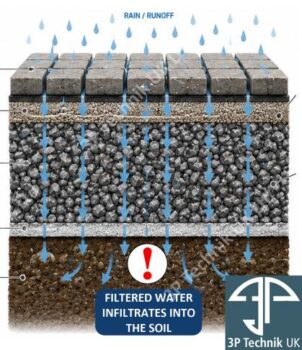
A typical PPS structure consists of:
- a permeable surface layer
- bedding course
- aggregate sub-base
- geotextile layer(s)
- underlying soil subgrade
Together, these layers provide structural support, water storage and treatment functionality.
Physical Filtration
As runoff infiltrates through the pavement surface, suspended solids become trapped within the pore spaces between aggregate particles.
Larger particles are typically retained near the surface, while finer particles can penetrate deeper into the pavement structure.
Adsorption
Contaminants may adsorb onto aggregate surfaces, organic matter and geotextile materials within the system. Some systems may also incorporate engineered media with enhanced adsorption capacity such as biochar, activated carbon or clays.
Biodegradation
Microbial activity within the pavement structure can contribute to the degradation of some hydrocarbons and organic pollutants over time.
However, biodegradation rates vary significantly depending on the molecular structure of the contaminant. Lower molecular weight (LMW) hydrocarbons may degrade relatively quickly, whereas many higher molecular weight (HMW) PAHs are highly persistent and degrade extremely slowly. They therefore can potentially increase over time if more are added than are degraded.
This distinction is important because PPS often act primarily as contaminant retention systems rather than complete contaminant removal systems.
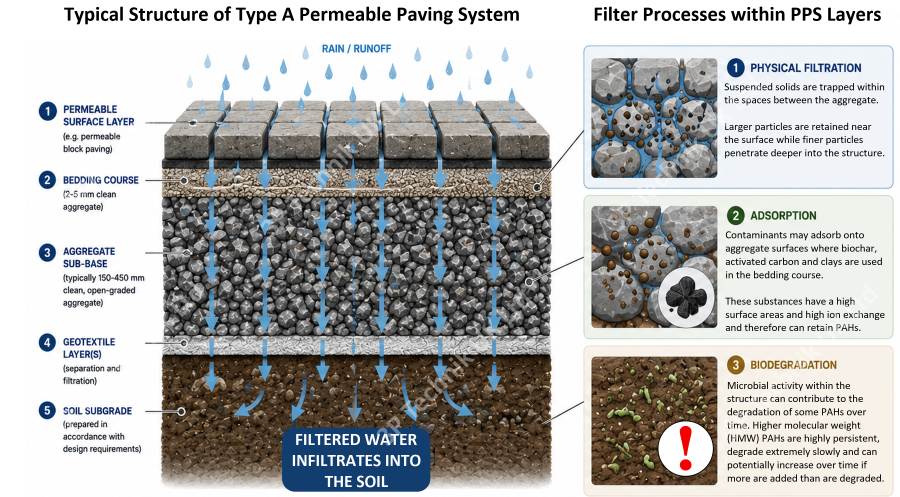
Typical Structure and Filtration Processes within Permeable Pavement Systems
Why Fine Sediment Behaviour Matters
The majority of PAHs within road runoff are associated with fine suspended solids (>64 microns) such as silts and clays.
These particles are particularly problematic because they:
- remain suspended for long periods
- are difficult to remove through simple sedimentation
- travel significant distances within drainage systems
- contribute heavily to pavement clogging
- and often contain the highest pollutant concentrations
This creates a fundamental design challenge for permeable pavements.
The same fine particles responsible for transporting the greatest pollutant loads are also the particles most likely to reduce infiltration performance over time.
For a wider discussion on contaminant transport associated with TSS, see: Total Suspended Solids in Road Runoff and Associated Contaminants.
What the CIRIA SuDS Manual Says About Permeable Pavements
The CIRIA SuDS Manual recognises permeable pavements as an important source control SuDS technique but also highlights clear limitations regarding sediment loading and site suitability.
Chapter 20 of the CIRIA SuDS Manual advises that permeable pavements should be avoided where there is a high risk of excessive silt loading onto the surface.
This guidance is particularly relevant when considering PAHs because elevated PAH concentrations are strongly associated with fine sediment fractions.
In practice, the locations generating the highest PAH loads are often the same locations generating:
- high concentrations of silts and clays
- elevated traffic-related contamination
- accelerated clogging risk
- and increased maintenance requirements
Typical examples include:
- heavily trafficked urban roads
- industrial estates
- logistics yards
- commercial servicing areas
- distribution centres
- waste handling facilities
- sites with frequent HGV turning movements
For these locations, the CIRIA guidance is highly significant. Excessive fine sediment loading can progressively block infiltration pathways within the pavement structure, reducing hydraulic performance and increasing maintenance frequency.
This means the suitability of PPS cannot be assessed solely on hydraulic storage or runoff reduction performance. Long-term sediment loading and contaminant accumulation must also be considered.
Where PPS Are Typically Most Effective
Permeable pavements are generally most effective in environments where both structural loading and sediment generation remain relatively moderate.
Typical suitable applications include:
- residential developments
- private driveways
- lightly trafficked car parks
- pedestrian areas
- cycle routes
- schools/playgrounds
- low-speed residential streets
- fire access routes with infrequent HGV use
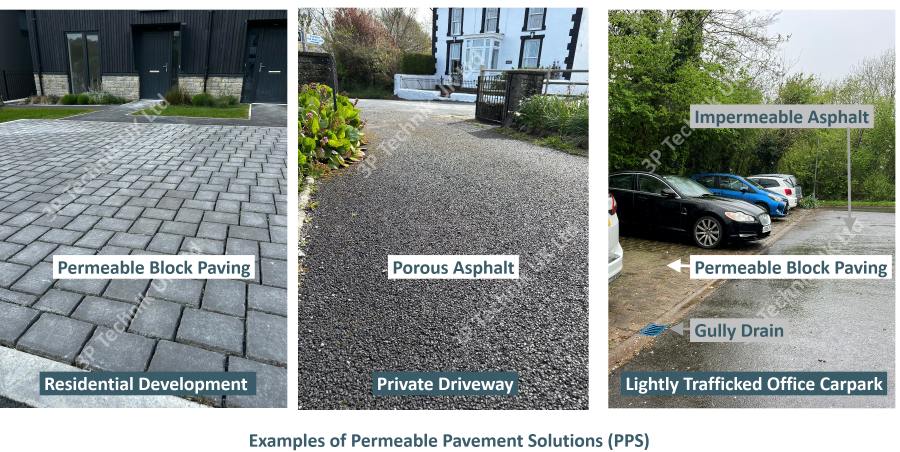
In these environments, PPS can provide effective:
- source control
- runoff reduction
- attenuation storage
- and water quality improvement
while maintaining acceptable structural and hydraulic performance over their operational life.
Permeable block paving is widely used in residential and public applications because of its flexibility, ease of maintenance and visual appearance.
Porous asphalt systems may also be selected where higher infiltration rates are required or where larger surface areas are being drained.
Importantly, these lower traffic environments also tend to generate lower contaminant loads than major highways or industrial sites.
Why PPS Are Less Suitable for Heavy Traffic Areas
Although permeable pavements can technically be engineered for heavier loading applications, their use within heavily trafficked environments remains relatively limited.
The main concerns include:
- high axle loading
- repeated braking and turning stresses
- rutting and surface deformation
- aggregate movement within pavement layers
- structural instability over time
- accelerated clogging from fine sediment accumulation
These factors are particularly problematic because the highest PAH concentrations are typically associated with the very environments where PPS are least suited structurally and hydraulically.
Road runoff from heavily trafficked urban roads and industrial sites commonly contains:
- elevated fine sediment concentrations
- tyre wear particles
- metals
- and persistent organic pollutants such as PAHs
This creates a conflict between:
- where pollutant treatment is most needed, and
- where permeable pavements are most practical to implement
For this reason, PPS are often avoided as the primary treatment solution for major roads, industrial yards and heavily trafficked commercial sites.
Permeable Pavement Systems and PAHs – The Long-Term Fate
One of the most important but often overlooked questions is, What ultimately happens to contaminants retained within permeable pavements systems like PAHs?
While some organic pollutants may biodegrade over time, many higher molecular weight PAHs are highly persistent and resistant to degradation.
As a result, contaminants may progressively accumulate within:
- the bedding layer
- aggregate sub-base
- geotextile interfaces
- and underlying soil subgrade
This has important implications for long-term asset management and maintenance planning.
Over time, accumulation of contaminated fine sediments may contribute to:
- declining infiltration performance
- progressive clogging
- increased maintenance requirements
- contamination of removed sediments
- and eventual replacement of pavement materials
The issue is not simply hydraulic performance, but also contaminant storage within the pavement structure itself. In many cases, PPS do not permanently eliminate PAHs from the environment. Instead, they transfer contaminants from the runoff into the pavement system where they remain stored until removed through maintenance or reconstruction activities. Over time, persistent PAHs retained within the sub-base and soil layers may also become available to microorganisms and soil fauna such as earthworms, creating a potential pathway for contaminants to enter wider terrestrial food chains. This raises important lifecycle considerations for SuDS designers, particularly where:
- high contaminant loads are expected
- maintenance access is limited, or
- long-term sediment management has not been fully considered
Where contaminated sediments accumulate significantly, removed materials may also require controlled handling or disposal depending on contaminant concentrations.
Why Treatment Trains Are Often Necessary
For higher-risk runoff catchments, permeable pavements are often most effective when used as one component within a wider SuDS treatment train rather than as a standalone treatment solution.
Modern stormwater treatment strategies increasingly combine:
- Source control
- Sediment separation
- Fine particle filtration
- Adsorption processes
- Attenuation and flow control
This approach is particularly important where runoff contains high concentrations of fine suspended solids and associated contaminants such as PAHs and heavy metals.
Proprietary treatment systems can provide enhanced removal of fine suspended solids before runoff enters infiltration systems or receiving waters.
Hydrodynamic separators such as the HydroShark can reduce coarse sediment loading and help protect downstream treatment assets from excessive sediment accumulation.
For sites with higher contaminant risks, advanced filtration systems such as the HydroSystem 1000 and HydroSystem 1500 are designed to target finer suspended solids and associated contaminants that conventional sedimentation systems may not effectively remove.
Unlike permeable pavements, these systems can also be installed effectively within heavily trafficked roads and industrial environments where infiltration-based systems may be impractical or unsuitable.
Conclusion
Permeable Pavement Systems remain an important SuDS technique for source control, runoff reduction and water quality improvement in suitable environments.
However, when considering persistent contaminants such as PAHs, it is important to recognise both the strengths and limitations of PPS.
While permeable pavements can effectively retain sediment-bound pollutants under moderate loading conditions, their long-term performance is heavily influenced by:
- fine sediment loading
- clogging risk
- maintenance regimes
- and contaminant accumulation within the pavement structure
The CIRIA SuDS Manual appropriately advises caution where high silt loading is expected, particularly because the highest PAH concentrations are strongly associated with the finest sediment fractions.
For residential developments and lightly trafficked applications, PPS can provide highly effective SuDS performance. For heavily trafficked roads, industrial sites and high contamination risk catchments, treatment trains incorporating sediment separation and advanced filtration technologies are often required to achieve effective long-term management of PAH-contaminated runoff.
3P Technik’s technical team can provide project-specific advice and support. Please contact us to discuss your requirements.
Full 3P Technik Technical Paper
 The 3P Technik Technical paper “Can Permeable Pavement Systems Treat PAHs?” investigates how PPS retain PAH-contaminated sediments in suitable SuDS applications, but long-term accumulation, clogging risks and site suitability limitations require careful design consideration.