
Understanding PAHs in Stormwater Runoff
Stormwater runoff is a significant pathway for pollutant transport into receiving water bodies. Among these pollutants, Polycyclic Aromatic Hydrocarbons (PAHs) are a main concern in stormwater treatment, due to their persistence and toxicity in our environments. Particle Size Distribution (PSD) aids in determining how PAHs behave- in terms of their transportation, bioavailability and fate in stormwater and surface water runoff. Knowing this behaviour and the PSD is critical for effective sustainable drainage systems being implemented to treat and remove these pollutants from runoff.
What is Particle Size Distribution (PSD)?

Blog Post: Relative sizes of particle types found in stormwater run off infographic
Particle Size Distribution (PSD) describes the particle size ranges present within surface water runoff. The general categorised particle sizes are:
| Particle Type | Particle Size (microns µm) |
|---|---|
| Clay | <2 |
| Fine Silt | 2-6 |
| Medium Silt | 6-20 |
| Coarse Silt | 20-63 |
| Fine Sand | 63-200 |
| Medium Sand | 200-600 |
| Coarse Sand | 600-2,000 |
| Fine Gravel | 2,000-6,000 |
| Medium Gravel | 6,000-20,000 |
What are Polycyclic Aromatic Hydrocarbons (PAHs)?
PAHs are lipophilic compounds, meaning they dissolve in fats and oils, and can therefore bioaccumulate in living organisms in aquatic or terrestrial environments. Due to this bioaccumulation and the inability of animals to adapt to the water quality degradation and toxic environments, aquatic food webs may be destroyed. Stormwater runoff allows PAHs to potentially enter the human body through digestion of aquatic organisms from contaminated waters, the contamination of drinking water supplies or by entering contaminated bathing waters for recreational use. Many acute and chronic health risks are posed to humans and animals from PAHs, including fertility issues, liver/ kidney damage, respiratory issues, heart disease and potentially cancer variants.
Sources of Polycyclic Aromatic Hydrocarbons (PAHs) in Urban Runoff
PAH sources include those of pyrogenic or petrogenic nature. Pyrogenic PAH sources are from the incomplete combustion of organic matter like coal, fuel or wood at high temperatures. These can be from vehicle engines, domestic heating, burning or cooking and industrial processes. Pyrogenic sources tend to produce a higher abundance of high molecular weight PAHs (> 4 rings), which are generally more hydrophobic (water-repellent).
Petrogenic PAH sources are the release or leaching of petroleum products which contain PAH content naturally. They form at lower temperatures over a longer time period. This can be from vehicle oil leaks, tyre and brake wear, coal-tar pavements sealants, or road abrasion. Typically, petrogenic sources produce a higher concentration of low molecular weight PAHs (2-3 rings), which are more water soluble than higher molecular weight PAHs, making them more mobile in our environments.
In an urban setting, vehicle emissions (both pyrogenic and petrogenic) are one of the most dominant sources of PAHs (Xiao et al., 2025). This includes PAH released from exhaust fumes from the engine, tyre wear, brake wear and oil and fluid leakages which are deposited and then transported via stormwater runoff. Concerns for human health as well as a wider general environmental degradation from tyre wear particle (TWP) pollution has increased significantly in recent years. PAHs that are released from TWPs originate from the use of additives like carbon black and processing oils being added within the manufacturing process of rubber tyres.
What particle sizes do PAHs bind to in stormwater runoff?
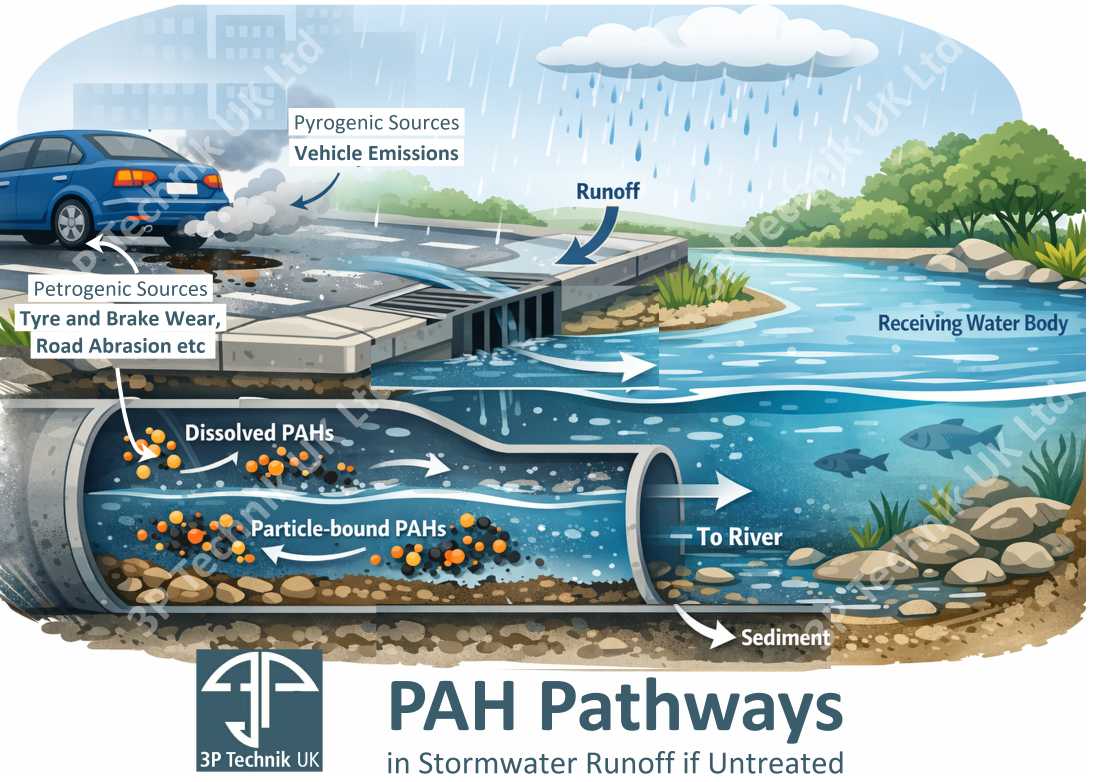
PAHs Pathways in Stormwater Runoff if Untreated
PAHs are persistent in stormwater runoff as they have low water solubility (hydrophobic characteristics) and resist natural degradation. Their persistence differs based on their sources, for example, it is known that as pyrogenic sourced PAHs tend to be strongly associated with particles in stormwater runoff, they can settle and contaminate aquatic sediments- which degrades natural waters and risks the survival of animals and vegetation within the water.
Differently to this, petrogenic PAHs are more water soluble (solubility for all PAHs is still relatively low), meaning they are more mobile in our environments once dissolved. These low molecular weight PAHs pose higher bioavailable risks in aquatic environments as organisms and vegetation can absorb more readily- bioaccumulation can take place increasing health risks to trophic levels.
PAHs are also characterised by their high sorption to organic matter, meaning they can attach to a range of particle sizes depending on the particles’ organic content. Stormwater runoff can contain organic matter in the form of leaves, grass cuttings, fertilisers and other debris types that are entrained within the flow of water before being discharged to a receiving water body.
Why fine particles carry the higest PAH loads
Overall, in stormwater PAHs are primarily found bound to sediment particles rather than in their dissolved phases due to their hydrophobic nature. Studies show that fine particles – consisting of clays, silts and fine sands – contain the highest concentrations of PAHs (Krien and Schorer, 2000, Rehwagen et al., 2005, Pietari et al., 2016). This is due to their hydrophobicity, which makes them readily adsorb onto particle surfaces. Smaller particles also have a higher surface area per unit mass compared to larger particles so are more able to adsorb pollutants. Silts are the most favourable particle size for PAHs to bind to, with clays having high PAH association and sand having a lower association. These smaller particles are of course the hardest to remove from stormwater runoff. but as they contain high contamination concentrations, they therefore do need to be managed or removed effectively and efficiently.
The fine particles PAHs are bound to have low settle velocities; therefore, can remain in suspension for longer time periods and therefore travel further in our environment. This can potentially spread contamination into a wider receptor zone, creating more ecological impact and the connectable land area that requires treatment becomes larger.
Why Assessing Particle Size Distribution is Essential for Managing PAHs in Stormwater
Knowing the PSD within a stormwater sample will help decide the best stormwater treatment control measure, as different particle size ranges require different treatment methods for effective PAH removal. Most SuDS sites require a treatment train of different stormwater treatment devices implemented in series. This improves system resilience and allows the removal of pollutants from stormwater runoff as different particle sizes and therefore contaminants can be targeted in each stage of the treatment train, meaning a wider range of sediment and pollutants can be removed.
Stormwater Treatment Train Design for PAH Removal
Effective removal of Polycyclic Aromatic Hydrocarbons (PAHs) from stormwater runoff requires a multi-stage approach. A SuDS treatment train combines different stormwater treatment devices in series to target a range of particle sizes and pollutant phases.
Stage 1 – Sedimentation (Coarse Solids Removal)
Sedimentation is the first stage in a stormwater treatment train and is designed to remove coarse particles such as sands and gravels. These larger particles have higher settling velocities and can be efficiently separated from the flow using hydrodynamic separators.
Systems such as the 3P HydroShark are engineered to operate under a range of hydraulic conditions, capturing and retaining sediments even during high-intensity short duration rainfall events. Remobilisation of previously removed sediment particles is usually a concern in stormwater management projects, but with 3P Technik’s design, remobilisation of particles and their associated contaminants are impossible.
While sedimentation is effective for coarse solids, it is not sufficient for PAH removal in isolation. PAHs are predominantly associated with finer particles, meaning that reliance on sedimentation alone will result in poor overall pollutant removal. However, this stage plays a vital role in protecting downstream systems by removing larger material.
Stage 2 – Filtration (Fine Particle Removal)

Stormwater Treatment of PAHs – 3P HydroSystem
Filtration systems are designed to target finer fractions of total suspended solids (TSS), including silts and clays where PAHs are most commonly bound. These particles are more difficult to remove due to their low settling velocities and tendency to remain suspended in the water column.
Advanced stormwater filtration systems, such as the 3P HydroSystem, utilise multi-process treatment including sedimentation, filtration, adsorption, and ion exchange. These systems can achieve high removal efficiencies for fine particles, with performance down to approximately 70 microns.
Filtration is therefore a critical stage in treating stormwater with high PAH concentrations, particularly in urban or high-traffic areas where fine particle loads are elevated. Without this stage, the majority of PAH-bound particles will pass through the treatment system untreated.
Note: Depending on the connectable area the 3P HydroSystem could also be used for Stage 1 (sedimentation) too.
Stage 3 – Adsorption Media (Dissolved Pollutant Removal)
While most PAHs are particle-bound, a proportion exists in dissolved form, particularly those from petrogenic sources. These dissolved contaminants cannot be removed through sedimentation or filtration alone.
Adsorption media is therefore required as a final polishing stage to remove dissolved PAHs and other residual pollutants. This stage enhances overall treatment performance and ensures that both particulate and dissolved pollutant pathways are addressed.
The 3P HydroSystems are certified multi stage treatment process devices that also remove desolved pollutants. As the waters flow upwards through the device, the dissolved pollutants are precipitated and absorbed into the unique filter media. Pollutants, once bound, cannot be remobilised from the filters by road salts in the incoming stormwater. It is certified to remove a proportion of the fine particles like silts and clays that PAHs are bound to. The larger systems (HydroSystem 1500 and 2500) can be used in heavy traffic areas where PAH concentrations are typically highest due to the incomplete combustion of organic matter in a vehicle’s engine, which release PAH particles in the exhaust fumes.
Linking PSD to Effective SuDS Design
Understanding particle size distribution is fundamental to effective SuDS design for water quality treatment. Since PAH removal efficiency is closely linked to the removal of specific particle size fractions, treatment systems must be selected accordingly.
Selecting the Right Treatment Devices Based on PSD
Stormwater treatment device selection should be directly informed by PSD analysis.
- Runoff with a coarse PSD can be effectively treated with sedimentation systems
- Runoff dominated by fine particles requires filtration systems
- Sites with elevated dissolved pollutant loads require adsorption media
Hydrodynamic separators and other systems relying on particle settlement may though still be of use in stormwater treatment design, typically in advance of a second and third treatment step in a treatment train. Great care must be taken in deciding on the second stage unit, as PAHs can be highly persistent in both water and soil environments.
In practice, most urban sites require a combination of all three stages. For example, high PAH concentrations are typically associated with fine particles, indicating the need for both filtration and adsorption processes. Systems designed only for coarse material removal will fail to capture the majority of PAHs and may allow ongoing highly persistent pollution of receiving water bodies and soil environments.
Maintenance and Performance Considerations
A well-designed treatment train not only improves pollutant removal but also enhances long-term system performance. Installing sedimentation upstream of filtration and adsorption stages reduces the risk of clogging and blockage, which are common causes of reduced efficiency and increased maintenance frequency.
By removing coarse material early in the process, downstream systems can operate more effectively and require less frequent intervention. This staged approach supports SuDS performance optimisation and ensures that maintenance intervals are manageable over the system lifecycle.
Conclusion
Polycyclic Aromatic Hydrocarbons are toxic chemicals that must be removed from stormwater runoff before it enters receiving waters. Without their removal, water quality degrades and whole aquatic ecosystems can collapse with the bioaccumulation of these pollutants making their way up food webs- potentially reaching human consumption.
Particle Size Distribution is essential to determine which combination of treatment processes will be appropriate to improve pollutant removal efficiencies and reduce environmental risks. Understanding and knowing the PSD also aids in calculating the appropriate maintenance intervals that must be undertaken for a stormwater treatment device or stormwater treatment trains. Installing incorrect treatment technologies to the wrong contamination profiles in a site can lead to lower performance levels and higher maintenance requirements for the sustainable drainage system technologies installed.
Author: Alys Bradshaw, 3P Technik UK Ltd.
Treatment Solutions for PAHs in Stormwater and Road Runoff
Our industry-leading treatment systems are specifically engineered to provide proven, reliable Polycyclic Aromatic Hydrocarbon removal in stormwater applications, ensuring performance you can trust both now and into the future.
3P Technik’s technical team can provide project-specific advice and support. Please contact us to discuss your requirements.
References
- Abdel-Shafy, H.I. and Mansour, M.S.M. 2016. A review on polycyclic aromatic hydrocarbons: source, environmental impact, effect on human health and remediation. https://www.sciencedirect.com/science/article/pii/S1110062114200237?ref=pdf_download&fr=RR-2&rr=9aab9c4adf527755
- Bathi, J.R., Pitt, R.E. and Clark, S.E. 2011. Polycyclic aromatic hydrocarbons in urban stream sediments. https://onlinelibrary.wiley.com/doi/10.1155/2012/372395
- Evergreen. 2023. Stormwater particle size distribution &implications for BMP effectiveness. https://www.ezview.wa.gov/Portals/_1962/Documents/SAM/D3.5%20Final%20White%20Paper.pdf
- Gomez-Avila, C., Rao, B., Hussain, T., Zhou, H., Pitt, R., Colvin, M., Hayman, N., DeMyers, M. and Reible, D. 2025. Particle size-based evaluation of stormwater control measures in reducing solids, polycyclic aromatic hydrocarbons (PAHs) and polychlorinated biphenyls (PCBs). https://www.sciencedirect.com/science/article/pii/S0043135425002131
- Krein, A. and Schorer, M. 2000. Road runoff pollution by polycyclic aromatic hydrocarbons and its contribution to river sediments. https://www.sciencedirect.com/science/article/abs/pii/S0043135400001561
- Pietari, J., Oreilly, K. and Boehm, P. 2016. A review of PAHs. https://www.stormwater.com/stormwater-bmps/article/13024928/a-review-of-pahs
- Rehwagen, M., Muller, A., Massolo, L., Herbarth, O. and Ronco, A. 2005. Polycyclic aromatic hydrocarbons associated with particles in ambient air from urban and industrial areas. https://www.sciencedirect.com/science/article/abs/pii/S004896970400868X
- Shen, H., Tao, S., Wang, R., Wang, B., Shen, G., Li, W., Su, S., Huang, Y., Wang, X., Liu, W., Li, B. and Sun, K. 2011. Global time trends in PAH emissions from motor vehicles. https://pmc.ncbi.nlm.nih.gov/articles/PMC3816389/
- Szewczynska, M., Dabrowska, J. and Pyrzynska, K. 2016. Polycyclic aromatic hydrocarbons in particles emitted from the diesel and gasoline engines. https://www.pjoes.com/pdf-64914-24002?filename=Polycyclic%20Aromatic.pdf
- Xiao, S., Zhang, R., Wang, X., Zhang, Z., Song, W., Qin, Y., Pei, C., Chen, D., Zhang, Y. and Wang, X. 2025. Substantial reduction in vehicular PAH emissions and emerging roles of tire wear: tunnel-test in Guangzhou (2014-2019). https://www.sciencedirect.com/science/ article/abs/pii/S1352231025005333