
Stormwater treatment involves removing pollutants from stormwater runoff using various techniques to improve water quality before it flows into receiving water bodies or is even reused for other purposes.
Why is stormwater treatment needed?
Climate change is changing the natural hydrological system with more frequent and intense rainfall predicted for the UK. Couple this with urbanisation and the significant use of impermeable materials, the flood risk is increasing. Traditional drainage networks are designed to direct surface water runoff into receiving waters as quickly as possible. Water from conventional systems includes the debris and pollutants that are picked up and entrained within the flow. If the debris and pollutant-carrying solid particle content within the stormwater runoff doesn’t block up the drainage networks (and so potentially cause flooding) it flows into the receiving waters, contaminating them. This degrades water quality, creating detrimental short-term (acute) and long-term (chronic) effects on terrestrial and aquatic living organisms and their habitats, as well as human health. Road runoff pollutants carried within stormwater flow may include heavy metals, simple and complex hydrocarbons, bacteria, nutrients, microplastics, pesticides, litter, and sediments (TSS = Total Suspended Sediments).
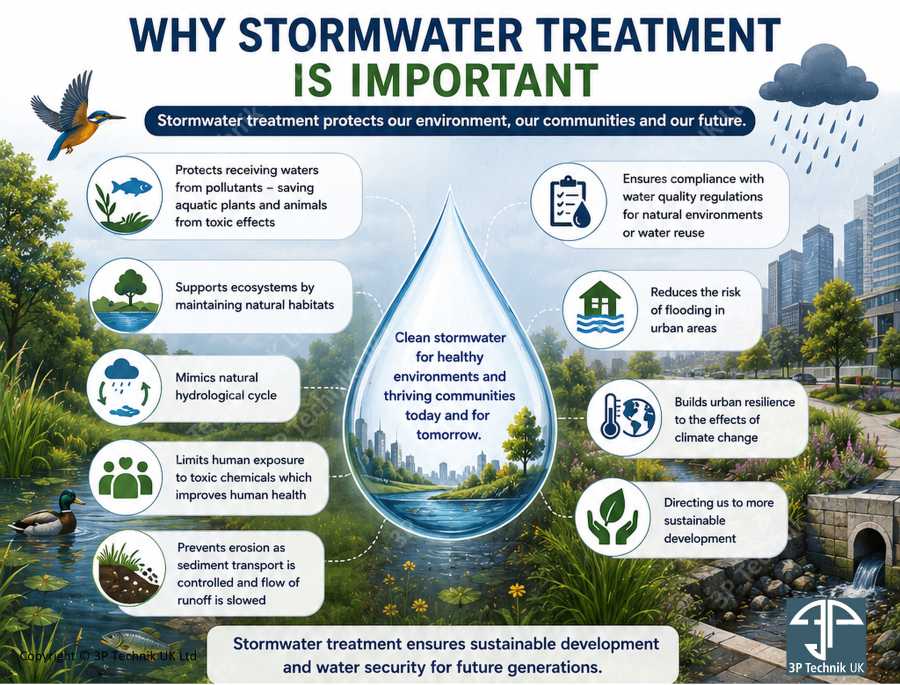
Stormwater management aims to control both the quantity and the quality of water flowing into receiving waters. Installing Sustainable Drainage Systems (SuDS) which mimic natural hydrological processes to slow, store and treat stormwater runoff reduces flood risk as well as pollutant migration. Stormwater treatment is the part of stormwater management which controls the quality of the stormwater.
Different types of stormwater treatment techniques
There are many different types of treatment techniques that can be categorised as Green Infrastructure or Grey Infrastructure- often called Soft SuDS or Hard SuDS devices. The specific technique selected for any project site should be dependent on the individual site characteristics, such as land use, space availability, particle size distribution within stormwater runoff and local rainfall patterns.
Table 1: comparison of the main components of Green and Grey Infrastructure for stormwater management.
| Green Infrastructure (Soft SuDS) | Grey Infrastructure (Hard SuDS) |
|---|---|
| Typically an above-ground structure | Typically a below-ground structure |
| Natural feature | Human-engineered system |
| Requires more space above-ground | Space-efficient |
Examples include:
| Examples include:
|
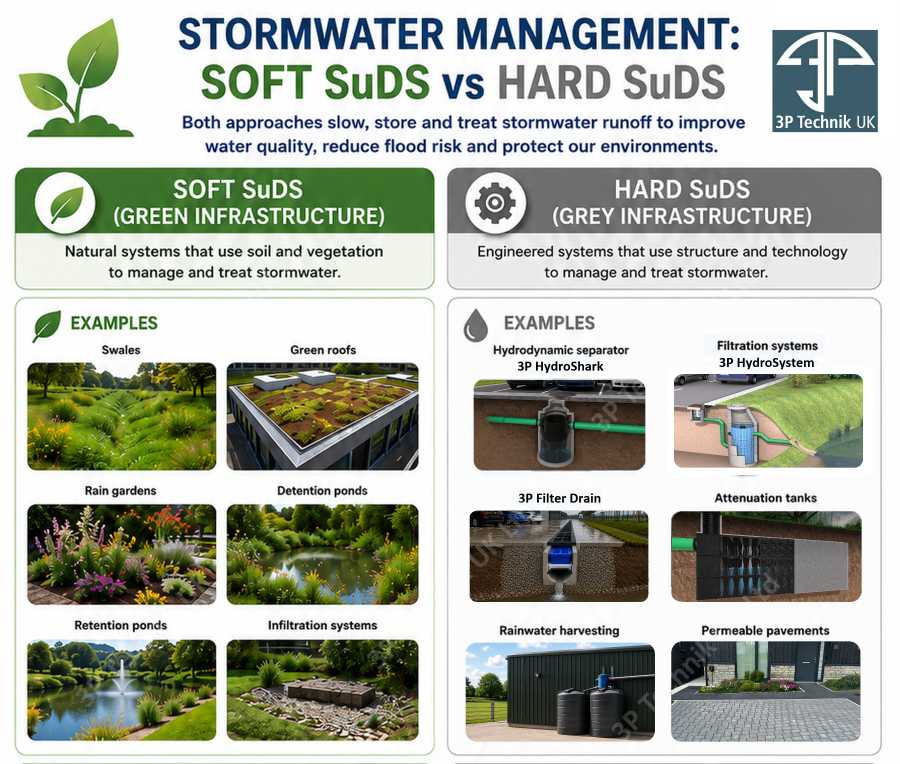
Green infrastructures are often easier to construct and maintain due to being above-ground. They can also promote biodiversity and amenity value. They can be susceptible to damage or vandalism from the public or weather events and risk becoming an eyesore or a failure if not maintained. In contrast grey infrastructure is often protected against vandalism/ damages that may occur, with many techniques being fully subsurface. These devices do though require proper planned knowledge on maintenance due to constrained workspace and to ensure remobilisation of pollutants does not occur. Due to the below-ground space-efficient system in grey infrastructure, the land directly above can be utilised for other purposes like road pavements or footpaths (often ideal for urban city areas). Grey infrastructure is typically more expensive in initial phases of design, but they can be installed in dense urban areas with long lifespans if maintained correctly. Many urban areas often experience a lot of pollution from traffic sources or industries and therefore require the reliable permanent pollutant removal methods that grey infrastructure can provide.
Green infrastructures can also remove unwanted pollutants from runoff through multiple different processes such as physical filtration, adsorption, sedimentation, ion exchange, microbial degradation and plant uptake. The use of soil and different vegetation planted within the systems (swales, green roofs, rain gardens, detention ponds, retention ponds, infiltration systems) drive these filtering processes and allows for pollutant capture. They also slow the flow of stormwater runoff, delaying the peak flow rate into receiving waters therefore controlling the quality and quantity of stormwater runoff that enters our natural environments. They will though accumulate persistent pollutants over time, like PAHs and metals.
Both green and grey infrastructure must be maintained to optimise performance levels of pollutant removal. Typically, grey infrastructure requires more expert knowledge on maintenance to ensure efficient performance, but many designed systems allow for no remobilisation or resuspension to take place once pollutants are captured. However, in green infrastructures once pollutants are captured, remobilisation or resuspension is possible if not removed completely from the system- especially during heavy rainfall or storm events. This makes ecological maintenance significantly important at regular intervals as well as after storm events. It is a fact that accumulation of persistent pollutants will take place within a green infrastructure’s soil and even vegetation.
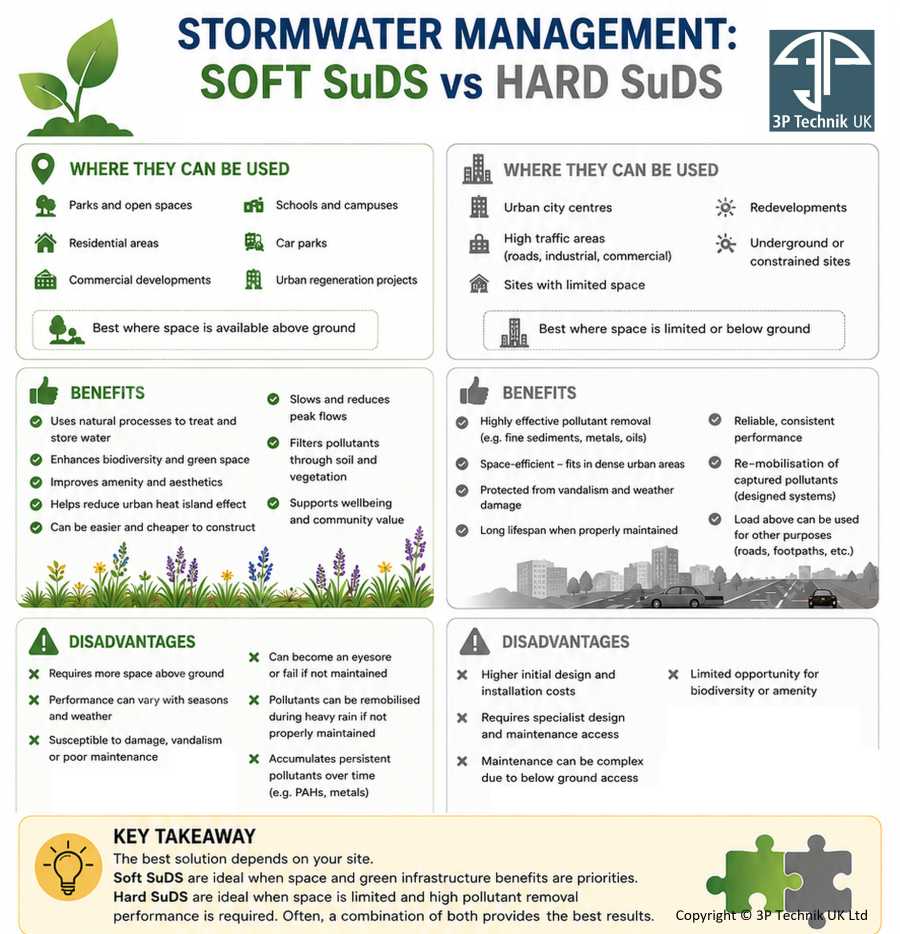
Examples of Hard SuDS
Hydrodynamic separators have been engineered to use gravity to remove settleable solids through vortex flow patterns and sedimentation.
Engineered filtration systems have been designed to remove fine particles (<64µm) through filtration and absorption. The remobilisation of previously removed solids is impossible, creating a clean unpolluted flow of water from the system.
Filter drains are gravel filled trenches combined with pipework that can filter out pollutants and store stormwater runoff, delaying peak discharges during rainfall events.
Attenuation tanks provide temporary storage for runoff before being discharged through a controlled release or reused for non-potable purposes. Some attenuation tanks filter the runoff before entering the tank, but its primary function is storage.
More detail on proprietary treatment systems can be found in Chapter 14 of the CIRIA SuDS Manual (2015), with design requirements for water quality laid out in Chapter 4 (Designing for water quality).
The Welsh and English’ SuDS Guidance addresses surface water runoff destinations in their first standard, with both publishing a priority level system for runoff destinations. Both state that priority level 1 is that “surface water runoff is collected for use”, which indicates the use of rainwater harvesting. This is the collection and storing of rainwater from roofs for future use. It can be treated depending on their intended use for different domestic or commercial purposes such as irrigation, flushing of toilets or car washing. This prevents water and any associated pollutants from entering receiving water bodies while also providing an additional source of water for non-potable uses.
Stormwater Treatment Trains
A combination of treatment techniques in sequence is called a stormwater treatment train. Treatment trains are considered better for pollutant removal efficiencies, often mimicking the natural hydrological processes that have been disturbed with anthropogenic structures such as roads and buildings. They provide multi-functional processes and an overall enhanced system resilience. This resilience comes from the different treatment processes that can target and afford the removal of a range of specific pollutants, ensuring a higher overall pollutant load reduction and less occurrence of a system blocking with sediments. If one treatment technique fails or becomes overwhelmed by the runoff volume and pollutant load, others are in place- resilience is built here through the continued treatment of stormwater runoff in some form. Treatment trains can also provide climate-related resilience for the future as they can generally withstand higher-intensity storms or increased runoff compared to one single process or technique being deployed.
The treatment techniques will vary and adjust to accommodate differing pollutant loads, pollutant inputs, local rainfall data and the Particle Size Distribution (PSD) found within the flow. Grey infrastructure such as a hydrodynamic separator is often best implemented in a treatment train before a green infrastructure system. The combination of SuDS devices used in series, one after the other, ensures efficient pollutant removal takes place to comply with regulatory requirements and runoff quantity control.
Why is stormwater treatment important?
- It protects receiving waters from pollutants- saving aquatic plants and animals from toxic effects
- Supports ecosystems by maintaining natural habitats
- Mimics natural hydrological cycle
- Limits human exposure to toxic chemicals which improves human health
- Prevents erosion as sediment transport is controlled and flow of runoff is slowed
- Ensures compliance with water quality regulations for natural environments or water reuse
- Reduces the risk of flooding in urban areas
- Builds urban resilience to the effects of climate change
- Directing us to more sustainable development
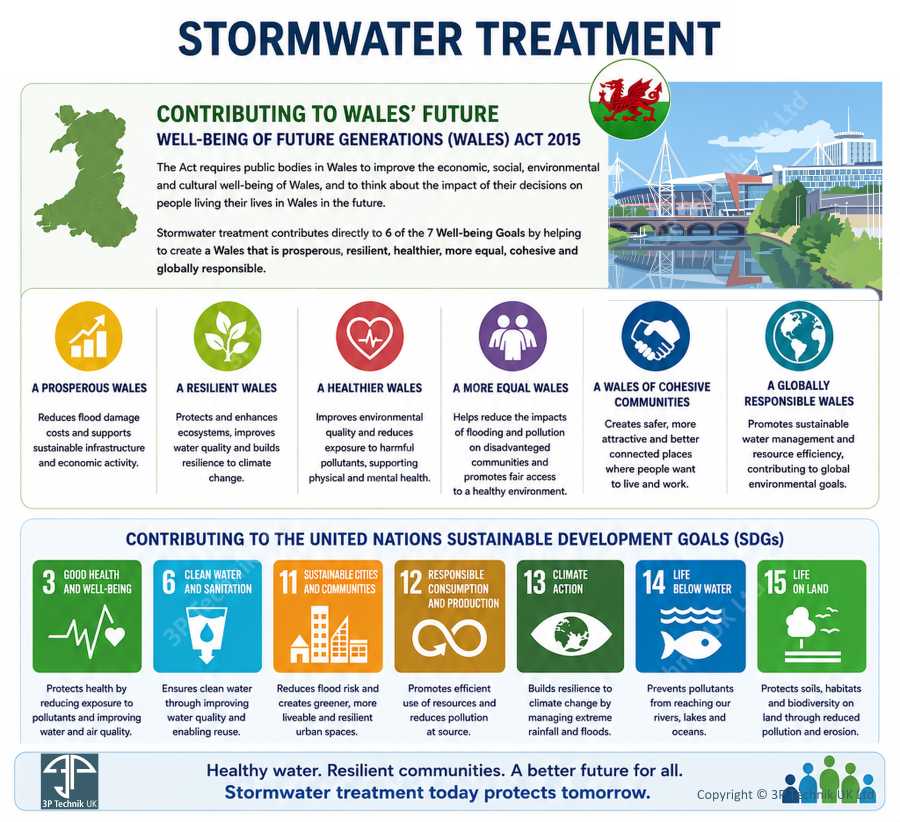
Stormwater treatment ensures sustainable development and water security for future generations and contributes to the following United Nations Sustainable Development Goals:
- 3. Good Health and Well-being
- 6. Clean Water and Sanitation
- 11. Sustainable Cities and Communities
- 12. Responsible Consumption and Production
- 13. Climate Action
- 14. Life Below Water
- 15. Life on Land
Stormwater treatment also contributes directly to six of the seven Well-being Goals established by the Well-being of Future Generations (Wales) Act 2015, particularly those relating to resilience, health, prosperity, cohesive communities, equality and global responsibility.
3P Technik Stormwater Treatment Products
3P Technik are experts in stormwater treatment and stormwater management. The 3P HydroShark HydroDynamic Separator is tested and certified alongside the NJDEP protocol, DIBt principles and the British Water Code of Practice which certifies the removal of hazardous pollutants. The hydrodynamic separator retains solids which are easily removed from the sludge chamber and should be emptied periodically to ensure efficient removal of pollutants and the clean flow of water discharged from the system.
The 3P filtration system-the 3P HydroSystem – is also certified under both the DIBt principles and the NJDEP protocol to remove sufficient pollutants through sedimentation, filtration, adsorption and ion exchange. A hydrodynamic separator is combined with a filter cartridge system to do so and these four steps of treatment applied to stormwater runoff removes coarse and fine particles. Fine particles offer a larger surface area per unit mass compared to larger particles for pollutants such as hydrocarbons or heavy metals to adsorb to. The smaller particles have the highest pollutant concentrations bound to them and therefore are of most concern in stormwater management to be removed permanently from stormwater runoff. The 3P HydroSystem allows for the removal of PM64 and is therefore a perfect system to be implemented in high traffic areas where pollutant concentrations are high.
The 3P Hydro Filter Drain also provides a space for sedimentation and filtration to remove unwanted and potentially hazardous chemicals from stormwater runoff. It is DIBt certified and doesn’t require much space to be installed. It is an at-surface solution for stormwater treatment and is popular with soft SuDS designers for this at-surface reason.
3P Technik also stock rainwater harvesting items included filters, pumps and water butts. Everything one would need to start a more sustainable and resilient water management future.
Stormwater treatment is essential for the survival of natural aquatic habitats and good ecological, animal and human health, as well as ensuring a sustainable, resilient hydrological cycle for future generations. 3P Technik offers a wide range of different products that guarantee effective treatment of stormwater runoff that can be installed below ground in high polluted areas.
To discuss your next project, please contact our technical team.
References
- Barbosa, A.E., Fernandes, J.N. and David, L.M. 2012. Key issues for sustainable urban stormwater management. https://www.sciencedirect.com/science/article/abs/pii/S0043135412003569
- CIRIA. 2015. The SuDS Manual.
- EPA. Green and Gray infrastructure research. https://www.epa.gov/water-research/green-and-gray-infrastructure-research
- EPA. 2022. Pure potential: the case for stormwater capture and use. https://www.epa.gov/system/files/documents/2022-03/wrap-pure-potential-report.pdf
- Feng, W., Liu, Y. and Gao, L. 2022. Stormwater treatment for reuse: Current practice and future development- a review. https://www.sciencedirect.com/science/article/abs/pii/S0301479721018922
- Future Generations Wales. https://futuregenerations.wales/
- Goonetilleke, A., Liu, A., Managi, S., Wilson, C., Gardner, T., Bandala, E.R., Walker, L., Holden, J., Wibowo, M.A., Suripin, S., Joshi, H., Bonotto, D.M. and Rajapaksa, D. 2017. Stormwater reuse, a viable option: Fact or fiction?
- https://www.sciencedirect.com/science/article/abs/pii/S031359261730053X
- Knapik, E., Brandimarte, L. and Usher, M. 2024. Maintenance in sustainable stormwater management: issues, barriers and challenges. https://www.tandfonline.com/doi/full/10.1080/09640568.2024.2325041#d1e142
- New Civil Engineer. 2008. Hard vs soft SuDS- weighing up the pros and cons. https://www.newcivilengineer.com/archive/hard-vs-soft-suds-weighing-up-the-pros-and-cons-07-05-2008/
- Sabut, A., Bhat, A.M. and Mohapatra, P.K. 2025. Stormwater control measures, design aspects, and impact of climate change- a review. https://www.sciencedirect.com/science/article/pii/S2588912525000347
- UK construction. 2018. The hard and soft of SuDS. https://www.ukconstructionmedia.co.uk/features/hard-soft-suds/
- UN. Sustainable Development Goals. https://sdgs.un.org/goals
- Uponor. Why do we treat stormwater, and how do we do it? https://www.uponor.com/en-en/why-do-we-treat-stormwater