
Water resources across the UK are facing increasing pressure from population growth, changing rainfall patterns and periods of drought. As a result, water reuse is becoming an increasingly important part of sustainable water management.
Water reuse involves collecting and treating water from various sources so it can be used again for practical purposes. These sources can include rainwater, stormwater runoff, greywater from domestic properties, and wastewater from industrial or municipal processes. The degree of treatment applied depends on the waters source, its intended future use and the consequent level of risk exposure from that reused water to members of the public.
By reducing reliance on mains water supplies, water reuse can help improve water security, lower costs and support environmental sustainability for future generations.
Why is Water Reuse Important?
Severe droughts and altered rainfall patterns due to the ever-going pressures from climate change, and inefficient water usage from the world’s increasing population have all contributed to the global water scarcity. Water resources around the world are under pressure and there is a current need to increase future resilience and sustainability of water supplies for the survival of future generations.
Water reuse provides an alternative water source that can:
- Reduce demand on mains water supplies
- Iprove resilience during periods of drought
- Reduce pressure on wastewater infrastructure
- Lower water bills and sewer charges
- Support sustainable development
- Reduce flood risk and environmental pollution
According to the UK Water Reuse Association (UK WRA), estimates that 50% of water used within homes can be supplied by non-potable water sources, reducing the need for treated water for hygiene, cooking and dishwashing purposes
Potable and Non-Potable Water Reuse
Water reuse can generally be divided into two categories: potable and non-potable reuse.
Potable Water Reuse
Potable water is water that has been treated to standards suitable for human consumption and domestic use. Strict regulations ensure that potable water is safe for drinking, cooking and personal hygiene.
There are two forms of potable water reuse:
Indirect Potable Reuse (IPR)
Indirect Potable Reuse is when the collected water is sent into an environmental buffer (e.g. groundwater source, river, reservoir) where it blends with other water and is later abstracted and treated up to standards when needed for use. The environmental buffer may also allow for natural purification to occur.
Direct Potable Reuse (DPR)
Direct Potable Reuse is captured water that has been treated and directly injected into drinking water supply for use.
Non-Potable Water Reuse
Non-potable water is not intended for human consumption but can be safely used for a variety of applications, including:
- Toilet flushing
- Garden irrigation
- Vehicle washing
- Laundry
- Fire-fighting systems
- Industrial processes like cooling machines
Non-potable water reuse is currently the most common form of water reuse in the UK.
Benefits of Water Reuse
Implementing water reuse systems offers numerous environmental, economic and operational benefits.
Water Conservation
Water reuse reduces dependence on traditional mains water supplies by making use of alternative water sources that would otherwise be lost.
Cost Savings
Using harvested or recycled water can reduce water consumption charges and sewerage costs, providing long-term financial savings.
Drought Resilience
Alternative water supplies help properties remain resilient during periods of water scarcity and drought.
Flood Risk Reduction
Capturing rainwater and stormwater reduces surface water runoff, helping to manage local flood risks and relieve pressure on drainage systems.
Environmental Protection
Water reuse can reduce pollutant discharges into rivers and streams, protecting aquatic ecosystems and improving water quality.
Biodiversity Support
Reducing water abstraction from natural sources helps protect wetlands, rivers and habitats that support biodiversity.
Sustainable Development
Water reuse contributes to more sustainable urban environments and supports long-term water resource management strategies.
Types of Water Reuse
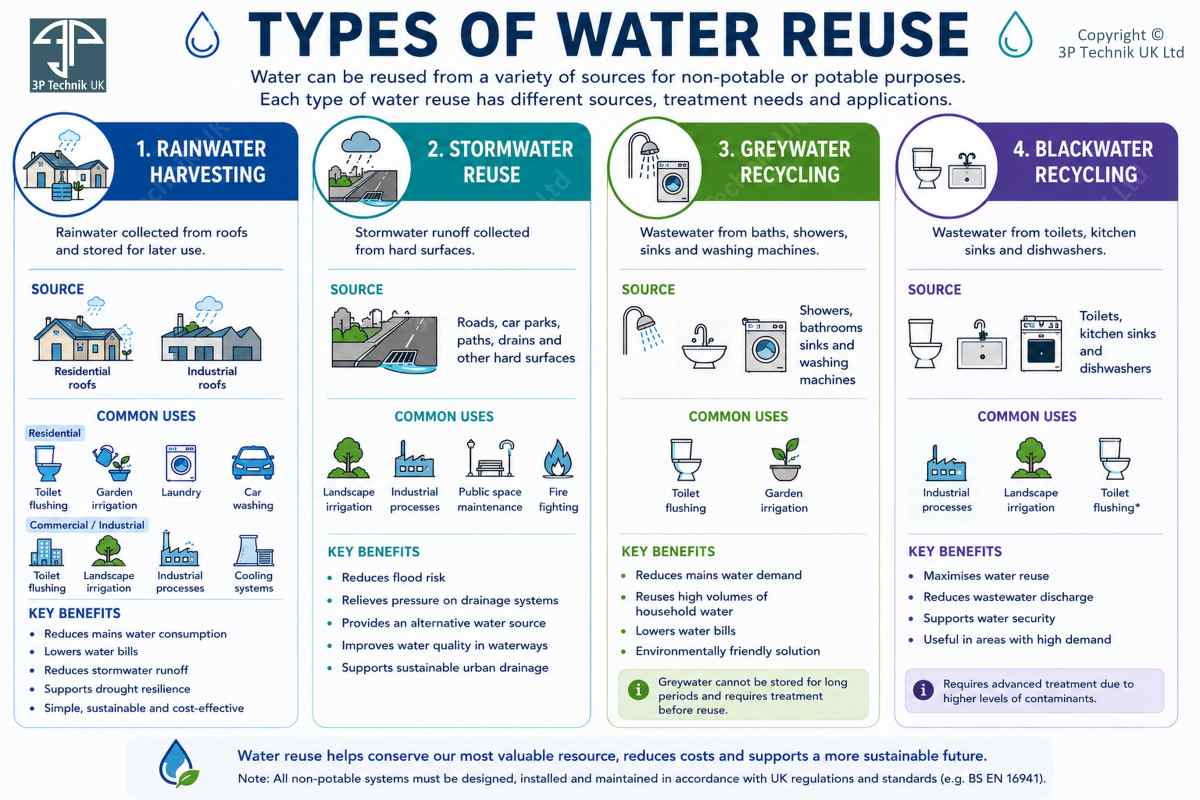
There are four common forms of water reuse that are used throughout the UK and internationally.
Rainwater Harvesting
Rainwater harvesting is one of the most practical and accessible forms of water reuse.
Rainwater is collected from roofs and stored for later use in non-potable applications such as toilet flushing, garden irrigation, vehicle washing and commercial processes.
Rainwater harvesting systems can be installed in:
- Residential properties
- Commercial buildings
- Industrial facilities
- Schools and Universities
- New developments
- Existing retrofit projects
Systems may serve individual properties or multiple buildings through communal water reuse systems.
Benefits of Rainwater Harvesting
- Reduces mains water consumption
- Lowers water bills
- Reduces stormwater runoff
- Supports sustainable development goals
- Improves drought resilience
- Provides a renewable alternative water source
Because rainwater is collected close to where it falls, it is considered one of the most efficient and sustainable forms of water reuse.
Rainwater Harvesting and SuDS Compliance
Rainwater harvesting plays an important role within Sustainable Drainage Systems (SuDS).
The SuDS Standards for England and Wales identify the collection and use of surface water runoff as the highest-priority destination for managing rainwater. This places rainwater harvesting at the top of the drainage hierarchy.
By incorporating rainwater harvesting into developments, designers can:
• Reduce surface water runoff
• Lower flood risk
• Improve water efficiency
• Support sustainable development objectives
Descending to lower priority levels should only occur when the maximum volume of surface runoff has been discharged to the higher priority levels first. To implement RWH into properties, especially new developments, you are therefore complying with the national SuDS standards in England and SuDS legislation in Wales.
Stormwater Reuse
Stormwater reuse involves capturing surface water runoff from impermeable surfaces such as roads, car parks and drainage systems.
Rather than allowing runoff to enter sewers or watercourses, stormwater can be collected, treated and reused for purposes such as:
- Landscape irrigation
- Public space maintenance
- Industrial processes
- Environmental enhancement projects
Stormwater runoff can all too often exceed the capacity of combined sewers during heavy rainfall events or storm events. Climate change may see this capacity exceedance increase. Capturing, treating and reusing this stormwater not only provides an alternative water supply but also reduces surface water runoff in urban areas (which reduces possible flood risks) and the concentration of pollutants entering our natural water ways. Stormwater collection is from impermeable surfaces like drains and roads rather than roofs like in rainwater harvesting and can be used in residential, industrial or public areas.
Greywater Recycling
Greywater is wastewater generated from:
- Showers
- Baths
- Bathroom sinks
- Washing machines
This water can be treated and reused within the same property, typically for toilet flushing and irrigation.
Kitchen sinks and dishwashers are generally excluded from greywater systems due to the high levels of fats, oils and grease they contain (see Blackwater Recycling).
Greywater cannot be stored for long durations as the stagnant water will develop an odour due to the bacteria and contaminants within it. It is treated before reuse to be aesthetically acceptable, although still classified as non-potable water.
Blackwater Recycling
Blackwater refers to wastewater from:
- Toilets
- Kitchen sinks
- Dishwashers
This water is highly contaminated with pathogens and harmful bacteria, therefore requires specialised advanced multi-stage treatment systems, consisting of biological, chemical and physical treatment steps.
Recycling and reusing black water techniques are uncommon in the UK, especially in domestic buildings due to the expensive installation costs, complex maintenance requirements and the long list of government health regulations that people must comply with.
The perception and resistance from members of the public in the UK towards this technology and where the water comes from may also be a barrier in their installations, even if it’s used for non-potable purposes.
Condensate Water Reuse
Air conditioning condensate is produced when warm, humid air passes over the cold evaporator coils within heating, ventilation and air conditioning (HVAC) systems. As the air cools, moisture condenses and is collected through a condensate drainage system. The resulting water is often described as being similar to distilled water due to its low mineral content.
While condensate volumes vary depending on climate, humidity levels and building usage, significant quantities can be generated by large commercial buildings, offices, schools, hospitals, data centres and other facilities with extensive cooling requirements. Condensate is often produced continuously during warmer periods when water demand for irrigation, cooling and other non-potable uses is typically at its highest.
With appropriate treatment and risk assessment, condensate water can be reused for a variety of non-potable applications including toilet flushing, vehicle washing, landscape irrigation and cooling system make-up water.
BREEAM and LEED building frameworks recognise HVAC condensate as a valuable alternative water source that can contribute towards reducing potable water consumption and improving overall water efficiency within buildings. As pressure on water resources continues to grow, condensate recovery represents another opportunity to treat water as a resource rather than a waste product, supporting wider objectives around resilience, sustainability and responsible resource management.
We have not included Air Conditioning Condensate reuse in this post. Air conditioning use is relatively low in the UK compared to warmer climates and installed in specialist commercial environments.
Water Reuse Regulations in the UK
- Natural Resources Wales (NRW) is responsible for the environmental regulatory standards in Wales, while the Environment Agency (EA) have these responsibilities for England.
- The Drinking Water Inspectorate (DWI) is an independent regulator for drinking water quality. They ensure that the strict standards are met with any water reuse intended for human consumption and other domestic purposes. They also ensure that Welsh and English water companies are complying with:
- The Water Industry Act 1991
- The Water Supply (Water Quality) Regulations 2016 (England) (as amended)
- The Water Supply (Water Quality) Regulations 2018 (Wales)
- The British Code of Practice for Rainwater Harvesting Systems (BS EN 16941) relates to on-site non-potable water systems for domestic and commercial use. It ensures consistency with design, construction, testing, maintenance and water quality outputs for rainwater harvesting systems across the country.
- Ofwat (Water Services Regulation Authority) is an economic regulator for the Welsh and English water and sewerage industries. Their main role is to ensure companies provide members of the public efficient services for domestic or commercial demand.
- RAPID (Regulators’ Alliance for Progressing Infrastructure Development) comprises of three water regulators- Ofwat, EA and the DWI. The partnership oversees strategic water supply projects to achieve long-term resource availability and resilience in Wales and England.
- The UK Water Reuse Association is the national trade association for water reuse, as well as rainwater harvesting and greywater recycling The UK WRA aims to make water reuse a predominant aspect within the UK’s sustainable water management plan to fight against the consequences of climate change such as water shortages and higher flood risk. The UK WRA suggest that legislation that applies to water reuse is revised and made mandatory by 2030.
These regulatory bodies ensure that water, that is being reused, is still safe to use for various purposes and doesn’t pose any health risks to humans.
The Future of Water Reuse
As climate change, population growth and water scarcity continue to challenge water resources, water reuse will play an increasingly important role in creating resilient and sustainable communities.
Whether through rainwater harvesting, stormwater reuse, greywater recycling or advanced wastewater treatment, reusing water helps reduce pressure on existing infrastructure while supporting environmental protection and long-term water security.
Among these solutions, rainwater harvesting remains one of the most practical and cost-effective approaches for homes, businesses and developers seeking to reduce mains water consumption and improve sustainability.
How 3P Technik Supports Water Reuse
3P Technik offers a range of rainwater harvesting solutions for domestic, commercial and industrial applications.
Our systems help property owners, developers and organisations make better use of natural water resources while reducing reliance on mains water supplies.
By implementing rainwater harvesting systems, you can contribute to a more sustainable and resilient future while supporting responsible water management practices. Contact us for more information.
References
- Bain, D. 2022. Why it’s important to reuse water. https://www.castlewater.co.uk/blog/why-its-important-to-reuse-water#:~:text=Water%20reuse%20is%20the%20process%20of%20treating,business%2C%20industry%2C%20farming%2C%20and%20the%20growing%20population**
- Barnett, J. 2024. How water reuse can address scarcity. https://www.eesi.org/articles/view/how-water-reuse-can-address-scarcity#:~:text=There%20are%20two%20types%20of%20potable%20water,immediately%20to%20the%20drinking%20water%20supply%20system.
- Begum, S., Rasul, M.G. and Brown, R.J. 2008. Stormwater treatment and reuse techniques: a review. https://www.researchgate.net/profile/Mohammad
- Rasul/publication/267242625_Stormwater_treatment_and_reuse_techniques_A_review/links/54db47b00cf2ba88a68fa68a/Stormwater-treatment-and-reuse-techniques-A-review.pdf
- Britannia Wash Systems. 2023. Recycling water: black water vs grey water. https://www.britanniawash.co.uk/blog/recycling-water-black-water-vs-grey-water
- BSI. British Standards. Rainwater harvesting systems- Code of Practice.
- DEFRA. 2025. National standard for sustainable drainage systems. https://www.gov.uk/government/publications/national-standards-for-sustainable-drainage-systems/national-standards-for-sustainable-drainage-systems-suds
- Department of Environment and Conservation NSW. 2006. Managing Urban Stormwater- Harvesting and Reuse. https://www.environment.nsw.gov.au/sites/default/files/managing-urban-stormwater-harvesting-reuse-060137.pdf
- DWI. Water recycling. https://www.dwi.gov.uk/water-recycling/
- EA. 2024. Creating a better place: Metting our water needs for the next 25 years. https://environmentagency.blog.gov.uk/2024/03/21/meeting-our-water-needs-for-the-next-25-years/
- EA. 2025. Water recycling for public water supply: Environment Agency position statement. https://www.gov.uk/government/publications/water-recycling-for-public-water-supply-environment-agency-position-statement/water-recycling-for-public-water-supply-environment-agency-position-statement
- EPA. Basic information about water reuse. https://www.epa.gov/waterreuse/basic-information-about-water-reuse
- European Commission. Water reuse. https://environment.ec.europa.eu/topics/water/water-reuse_en
- Feng, W., Liu, Y. and Gao, L. 2022. Stormwater treatment for reuse: Current practice and future development- A review. https://www.sciencedirect.com/science/article/abs/pii/S0301479721018922
- Ofwat. About RAPID. https://www.ofwat.gov.uk/regulated-companies/rapid/about-rapid/
- Ofwat. RAPID action on major water infrastructure is securing supply for future generations. https://www.ofwat.gov.uk/rapid-action-on-major-water-infrastructure-is-securing-supply-for-future-generations/
- The Welsh Government. 2018. Statutory standards for sustainable drainage systems- designing, constructing, operating and maintaining surface water drainage systems. https://www.gov.wales/sites/default/files/publications/2019-06/statutory-national-standards-for-sustainable-drainage-systems.pdf
- UK Gov. 2015. Water and treated water. https://www.gov.uk/government/publications/water-and-treated-water/water-and-treated-water#expertise-across-the-board
- UK WRA. https://www.ukwra.org.uk/about-uk-water-reuse-association
- UK WRA. Water Reuse Ready. https://www.ukwra.org.uk/_files/ugd/e42a91_bf07008105fa479d90e67dc692c15a38.pdf
- Vigneswaran, S., Kandasamy, J. and Ratnaweera, H. 2025. High-rate stormwater treatment for water reuse and conservation- review. https://www.mdpi.com/2076-3417/15/2/590
- Xylem. Water reuse: solutions for sustainability, efficiency and resilient water systems. https://www.xylem.com/en-uk/resources/articles/water-reuse-systems/
- World Water Week. 2025. Understanding water scarcity: causes, impacts and solutions. https://worldwaterweek.org/news/understanding-water-scarcity-causes-impacts-and-solutions