
Since publishing my last paper at the end of 2024, research on the impact of 6PPD and its derivative, 6PPD-quinone (6PPD-q), on fish, mammalian, and human health has made considerable progress.
As a brief overview, 6PPD is a common tyre additive and is therefore released into highway water runoff in environmentally significant concentrations.
6PPD is released into the natural environment it readily undergoes an oxidative transformation reaction, producing its derivative 6PPD-q. Therefore, it is no surprise that both 6PPD and 6PPD-q have been identified in various environmental settings (atmospheric, aquatic, soil and sediments)1.
I am about to graduate from my BSc in Biomedical Sciences, so it is the human and genetic approaches in science that interest me. This update paper, like the last, will focus mostly on animals and human responses to 6PPD and 6PPD-q.
As already stated, considerable progress has been made in this field. So, it is hard to fully encapsulate the whole field of research in this summary report, written from a Biomedical Sciences perspective.
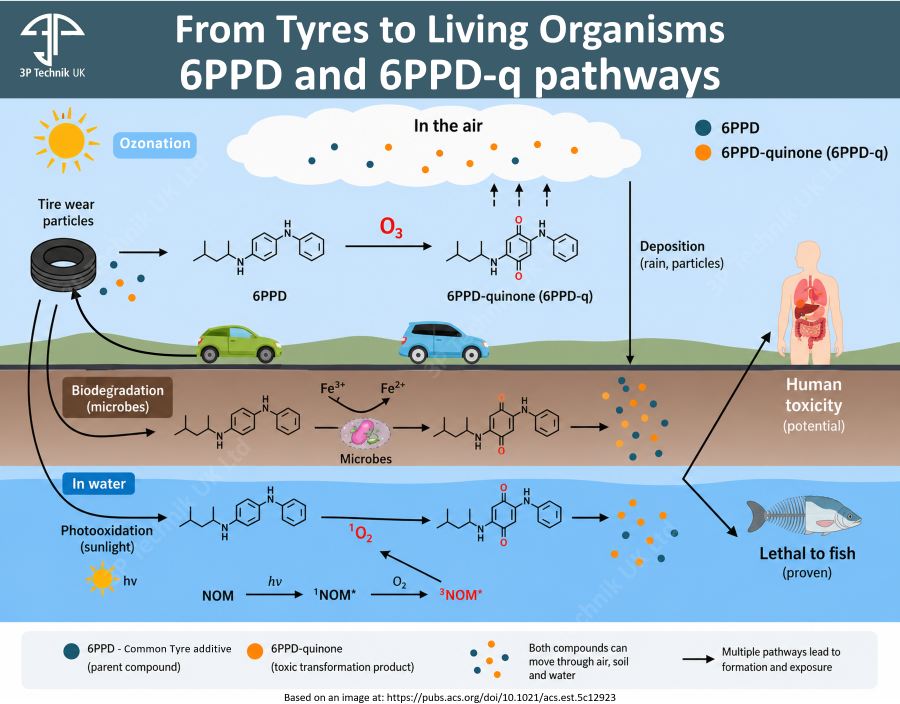
6PPD and 6PPD-q pathways from Tyres to living organisms
Fish
As discussed in my first paper, most of the foundational research has been carried out with respect to the effect on aquatic fish species. Although most of the research focuses on fish, much research remains to be investigated, with many old and new questions being raised.
Species specificity
Fish seem to respond to 6PPD and 6PPD-q in a species-specific manner. The reasons for this difference in susceptibility between fish species remain unclear.
Perhaps the most popular current theory hypothesises a link between physiological response to 6PPD and 6PPD-q and biotransformative enzyme levels present in the fish.
For example, cytochromes (superfamily of enzymes with a heme cofactor) may influence the toxicity of 6PPD in fish. Specifically, Cytochrome P450 may influence biotransformation pathways, including inducing transformation of 6PPD to 6PPD-q, and so correlating with acute toxicity (in fish species that are considered more ‘sensitive’ to environmental 6PPD).
Another study investigated the intestinal microbial community, identifying differences between the Zebrafish (tolerant) and Coho Salmon (more sensitive) species. Zebrafish microbial communities are capable of detoxification of 6PPD-q, and have a higher binding affinity between the enzymes present and 6PPD-q.2
Consequences of 6PPD and 6PPD-q pollution
My 2024 paper provided an overview of the established research at the time. Current research continues to support that the cause of 6PPD-linked mortality, also known and researched as Urban Runoff Syndrome (URS), is likely linked to vascular disruption.
The ability of 6PPD-q to cross the Blood-Brain Barrier (BBB) has also been long established, but the effects and mechanisms are yet to be agreed on within research. Some in vitro (i.e. experiments performed outside of a living organism in controlled conditions) studies have shown 6PPD-q to enhance permeability of the BBB, but no effect on the number of healthy and viable cells in the sample was observed. These findings suggest that 6PPD-q compromises BBB integrity but doesn’t directly cause cell death (within a cell sample).
Model organisms and animals
In bioscience, model animals and organisms are an important method of study. Results from model animals can be used to infer what may be potentially happening in humans.
A recent study investigated rat and human livers in order to investigate the metabolism of 6PPD-q.3 The study highlights the liver as an important site of 6PPD-q metabolism in mammals.
Similarly to fish, the gut microbiota of mice has been studied in relation to 6PPD toxicity4. It seems that both 6PPD and 6PPD-q toxicity cause a significant decrease in microbiota richness in the mouse gut. By disrupting the gut microbiota, lipid metabolism is altered, which has wider implications within the body. For example, the immune system may be compromised, impacting the intestinal barrier.
Caenorhabditis elegans (C.elegans), a eukaryotic nematode, is also a typical model organism. 6PPD has been shown to shorten the lifespan and health span of the C.elegans. A study linked 6PPD to the insulin signalling pathway; disruption of this pathway can lead to reduced stress resistance and a faster ageing process, explaining the results observed in C.elegans.5
Studies in C.elegans have introduced a neurological concern. Long-term exposure to 6PPD-q led to abnormal locomotion due to neurodegeneration.6
Humans
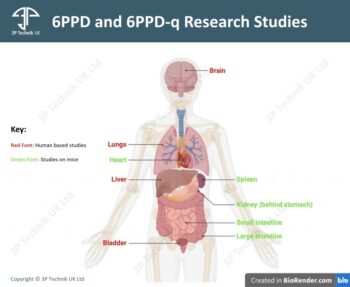
Annotated diagram of the human body. Red font indicates organs that have been studied in human-derived samples or human-focused studies. Green font indicates organs that have been investigated in mouse studies and are therefore likely also present in the human system.
Not shown: circulatory and immunological systems, where 6PPD is highly suggested to be implemented.
(Also note this is by no means an exclusive list of the potential affected human organs)
As mentioned in my 2024 article, 6PPD-q has been detected in human urine samples. Further research has since been undertaken. Yang et al. (2024) reported the first detection of 6PPD-q in whole blood samples from pregnant females and umbilical cord samples.7 The transfer of 6PPD into the placenta has been studied in mice, raising a significant area of potential concern.8 This highlights the need for further research into other vulnerable groups of individuals, as the pollutant is demonstrated to reach foetal circulation. Identification of biomarkers is also crucial and done in this study by Yang et al. 2024.7
In my previous article, the impact of 6PPD-q in male mice on spermatogenesis, leading to programmed cell death, was also discussed.
Staying on the subject of reproduction and gametogenesis, 6PPD-q within the ovarian granulosa cells of mice induced programmed cell death and Polycystic Ovary (PCOS) like changes. 6PPD-q activated an important signalling pathway (PI3K/AKT/PTEN) in mice, associated with cell death, and was also associated with clinical features observed in human patients with PCOS.9
6PPD and 6PPD-q have now also been implicated in respiratory health, affecting the human lungs. Apoptosis-related cell death pathways were predicted to be influenced in lung tissue, due to the pollutants disrupting a key process in the mitochondria. The mitochondria are cellular organelles responsible for producing ATP; cells rely on this process for energy. Due to this disruption within mitochondria and cell death, inflammation in the respiratory system may occur.10 Interestingly, this study begins to highlight the differences between the effects of 6PPD and 6PPD-q. Li et al. 2025 suggest 6PPD mainly induces a “chronic toxic effect”, whilst 6PPD-q is more likely to “induce acute injuries” in the context of molecular targets and mechanistic pathways in respiratory toxicity and health.10
It is suggested that multiple organs and systems within the human body may be potentially affected.
It seems the liver and circulating blood appear to be major sites of distribution of 6PPD and 6PPD-q in the human body 8 however, it must be noted that most studies to date have been done in vitro, or by in vivo assays (using relevant cell types or model animals).
Children
Concerningly, as mentioned in my first article, children can face higher exposure to 6PPD in their daily lives. A study showed that children with a higher estimated exposure to 6PPD were associated with lower Body Mass Index (BMI). Oral ingestion (from dust) of 6PPD has been associated with influenza and diarrhoea. Children growing up in environments with higher exposure to 6PPD, for example, waste recycling towns, are at much higher risk of these mentioned side effects.
It seems that oral ingestion correlates highly with observed side effects; in comparison, inhalation is less associated with these side effects.11
Risk exposure
Studies into various subpopulations show varying levels of 6PPD inhalation exposure, and within these population levels also varied between occupational groups. As well as in urban stormwater runoff, 6PPD can be found in dust, both on the road and within indoor household dust.
6PPD-q was first isolated and identified in urban runoff. 6PPD and 6PPD-q levels in urban runoff are heavily influenced by hydrological and climatic conditions. Specifically, rainfall and temperature levels are influencing factors, both of which are and will continue to be heavily influenced by climate change. Studies have shown that increased temperatures may lead to higher conversion rates from 6PPD to 6PPD-q in local environments.1
Atmospheric levels of 6PPD are generally low, but of course are heavily influenced by ozone levels, as this is what 6PPD reacts with (and oxygen) to form 6PPD-q.1
Future perspective
As mentioned in my 2024 paper, future studies need to include larger cohorts, especially with the rising awareness of certain subpopulations being more at risk than others. The identification of biomarkers would be incredibly beneficial in human sample studies.
Comparison of the effect of different levels of 6PPD exposure in human populations would be an interesting point of investigation.
Those subpopulations at greater risk of 6PPD pollution may face chronic exposure to 6PPD.
Long-term exposure to 6PPD is understudied, as expected due to the recent rise in publications and research into this subject area. Only time will tell what effects long-term exposure may have on humans and other animals, and what the actual risks of long-term exposure are.
Current published studies investigate 6PPD as an isolated compound, especially in vitro. This is not the case when 6PPD is present in the polluted cocktail of urban runoff. Future studies may consider the overall ecosystem and cycle of the rainwater system, and the pathway 6PPD takes from being a tyre additive to being present in the rainwater environment and its transformation to 6PPD-q.
Lastly, whilst this article has again deliberately taken a more biomedical science perspective in reviewing the current published research on this topic, it is apparent that there seems to be a lack of focus on wild animals, which of course, also face the threat of 6PPD.
Other animal and plant species should be considered in future research.
Opinion
Much has advanced in the study of 6PPD and 6PPD-q as a toxin in the human body, and yet every paper and study I have read for this update has only raised further concern. Perhaps, selfishly, as humans, we may only care once this issue begins to affect our own species.
There are very likely numerous unknown effects from this pollutant, long-term and short-term, yet to be identified. But as more 6PPD pollutes our stormwater every day, how long are we willing to wait to find out what the true effects of this tyre additive may be?
Once again, writing this update paper has led me to the same conclusion: stormwater pollution deserves the attention of the whole scientific community. As I write this on the 3rd day in a row that the UK has broken the record for the hottest June day ever recorded, it is increasingly apparent to me that this planet, and every animal and living organism it provides a home to, is also facing increasing environmental stresses as the climate shifts.
I am also aware of the large disconnect between the scientific community and the general population. In my past 4 years of study, I have struggled to read and understand many scientific papers, reviews and studies. It is true that 6PPD polluting stormwater is a complex and intangible issue to most. The potential impacts on the human body are hard to conceptualise when there are so many intricate systems, organs, cells and signalling pathways interacting.
In an age of misinformation online and in the media, it is hard to know what to trust and believe anymore. Deciding which issues should be investigated and managed next to protect our health as the climate shifts is increasingly difficult.
I hope this article makes a small contribution to scientific education becoming more accessible, and humans may begin to tackle this problem as a whole population together.
Directed Reading
I would like to draw attention to a recent review article I found extremely interesting and useful whilst writing this short update paper. It mentions many of the studies I have discussed and would be a good starting point if anyone wishes to read in more depth into the topic of 6PPD.
Wang et al. 2026. Occurrence, Transformation, and Toxicity of Tire-Derived Chemicals 6PPD and 6PPD-q in the Environment. Environmental Science & Technology 60(9) https://pubs.acs.org/doi/10.1021/acs.est.5c12923
Below is a link to my first article, published in 2024, also referenced throughout this updated article.
https://3ptechnik.co.uk/toxic-tyres-a-study-of-6ppd-in-stormwater/
Author: Tesni Hyett, BioMedical Sciences Graduate (Cardiff University).
References
- Wang, S., Xu, S., Lu, J., Wan, Y., Kang, Z., Chen, H., Islam, S., Gao, B. 2026. Occurrence, Transformation, and Toxicity of Tire-Derived Chemicals 6PPD and 6PPD-q in the Environment. Environmental Science Technology 60(9), pp 6862-6884. Doi: https://doi.org/10.1021/acs.est.5c12923
- Liao, X-L., Chen, Z-F., Liu, Q-Y., Zhou, J-M., Cai, W-X., Wang, Y., Cai, Z. 2024. Tissue Accumulation and Biotransformation of 6PPD-Quinone in Adult Zebrafish and Its Effects on the Intestinal Microbial Community. Environmental Science Technology 58(23), pp 10275-10286. Doi: https://doi.org/10.1021/acs.est.4c01409
- Zhang, Y-Y., Huang, J-W., Liu, Y-H., Zhang, J-N., Huang, Z., Liu, Y-S., Zhao, J-L., Ying, G-G. 2024. In vitro metabolism of the emerging contaminant 6PPD-quinone in human and rat liver microsomes: Kinetics, pathways, and mechanism. Environmental Pollution 345, 123514. Doi: https://doi.org/10.1016/j.envpol.2024.123514
- Fang, L., Xu, J., Fang, C., Jin, Y. 2025. Oral exposure to tire rubber-derived contaminant 6PPD and 6PPD-quinone induces intestinal toxicity in mice. Toxicology 518(154285) doi: https://doi.org/10.1016/j.tox.2025.154285
- Hua, X., Wang, D. 2023. Exposure to 6-PPD Quinone at Environmentally Relevant Concentrations Inhibits Both Lifespan and Healthspan in C. elegans. Environmental Science & Technology 57(48), pp. 19295-19303. Doi: https://doi.org/10.1021/acs.est.3c05325
- Hua, X., Feng, X., Liang, G., Chao, J., Wang, D. 2023. Exposure to 6-PPD Quinone at Environmentally Relevant Concentrations Causes Abnormal Locomotion Behaviors and Neurodegeneration in Caenorhabditis elegans. Environmental Science & Technology 57(12), pp. 4940-4950. Doi: https://doi.org/10.1021/acs.est.2c08644
- Yang. Y., Meng. W., Zhang. Y., Meng. W., Li, J., Liu. W., Su. G. 2024. Characterizing the Metabolism of Tire Rubber-Derived p-Phenylenediamine Quinones to Identify Potential Exposure Biomarkers in Humans. Environmental Science & Technology 58(41), pp. 18098-18108. Doi: https://doi.org/10.1021/acs.est.4c04693
- Zhao, H, N., Thomas, S, P., Zylka, M, J., Dorrestein, P, C., Hu, W. 2023. Urine Excretion, Organ Distribution, and Placental Transfer of 6PPD and 6PPD-Quinone in Mice and Potential Developmental Toxicity through Nuclear Receptor Pathways. Environmental Science Technology 57(36), pp. 13429-13438. Doi: https://doi.org/10.1021/acs.est.3c05026
- Yu, H. et al. 2025. Exposure to 6PPD-Q induces dysfunctions of ovarian granulosa cells: Its potential role in PCOS. Journal of Hazardous Materials 486, 137037. Doi: https://doi.org/10.1016/j.jhazmat.2024.137037
- Li, G., Li, D., Zhai, W., Liu, C., Chen, M., Xu, Q., Huang, Y. 2025. Respiratory toxicity mechanism of 6PPD and 6PPD-quinone: An integrated study based on network toxicology and molecular docking. Ecotoxicology and Environmental Safety 301, 118494. Doi: https://doi.org/10.1016/j.ecoenv.2025.118494
- Zhang, Z., Xu, X., Qian, Z., Zhong, Q., Wang, Q., Hylkema, M. N., Sneider, H., Huo, X. 2024. Association between 6PPD-quinone exposure and BMI, influenza, and diarrhoea in children. Environmental Research 247, 118201.