
Tyre wear particles (TWPs) are now recognised as a significant and largely unmanaged source of chemical contamination in urban stormwater. Among the most important tyre-derived chemicals are the vulcanisation accelerators mercaptobenzothiazole (MBT) and diphenylguanidine (DPG), which are used globally to produce durable, heat-resistant rubber. While essential to tyre performance, increasing evidence shows these additives pose persistent risks to aquatic ecosystems and, potentially, human health once released into the environment.
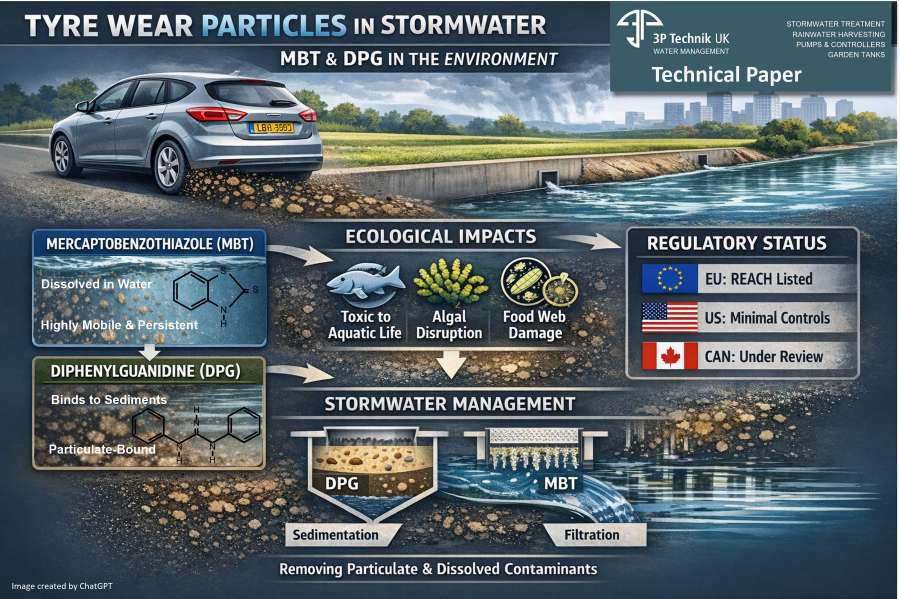
Summary of Tyre Wear Particles in Stormwater Road Run Off – MBT and DPG. Full Technical Paper Link.
Why MBT and DPG are Present in Stormwater
MBT (a thiazole compound) and DPG (a guanidine compound) are used synergistically during sulphur vulcanisation. Not all these additives are chemically bound within the finished tyre. As tyres abrade during normal driving, unreacted residues are released as TWPs, which are readily mobilised by rainfall and transported via urban runoff into stormwater networks and receiving waters.
Environmental Behaviour and Fate
The two compounds behave very differently in stormwater systems:
- MBT is predominantly found in the dissolved phase, making it highly mobile, bioavailable, and difficult to remove using conventional sedimentation alone.
- DPG preferentially associates with fine sediments, becoming particulate-bound and more amenable to removal through physical separation processes.
Both compounds are persistent, with MBT exhibiting long half-lives in aquatic environments (up to ~280 days under certain conditions). Recent studies have detected MBT and DPG in urban waterways, sediments, and even indoor dust, indicating widespread environmental distribution.
Ecotoxicological Concerns
Research increasingly shows that tyre-derived chemicals affect aquatic ecosystems at very low concentrations:
- MBT is highly toxic to aquatic life, inhibits algal growth, and is classified as Aquatic Acute 1 and Aquatic Chronic 1 under EU CLP. Its dissolved nature increases ecological risk through direct bioavailability.
- DPG has been shown to be moderately toxic to fish and extremely toxic to primary producers such as diatoms, which form the base of aquatic food webs. Reported EC50 values are in the sub-µg/L range.
- Combined exposure to MBT, DPG, and other tyre additives (e.g. 6PPD-quinone) can suppress algal productivity, disrupt oxygen generation, and destabilise entire aquatic ecosystems.
The issue is likely to intensify as vehicle weights increase, particularly with the transition to electric vehicles, which generate higher tyre wear rates.
Regulatory Status: Limited Controls, Growing Scrutiny
Regulatory approaches vary widely:
- EU: Both MBT and DPG are registered under REACH and classified as hazardous, but neither is currently restricted or subject to authorisation. Occupational exposure limits exist only in some member states.
- US & Australia: Both substances are listed under national chemical inventories with minimal restrictions, largely relying on general workplace safety guidance.
- Canada: MBT is tracked under pollutant release reporting, with further risk assessments underway; DPG is currently considered low risk at reported concentrations.
Overall, regulation has not yet caught up with emerging evidence of environmental harm, particularly in relation to stormwater pathways.
Implications for Stormwater Management
From a stormwater treatment perspective, TWPs and associated chemicals represent a clear treatment gap:
- Sedimentation alone can remove DPG-laden particles but is ineffective for dissolved MBT.
- Combined treatment trains incorporating hydrodynamic separation followed by filtration offer a more robust solution, targeting both particulate-bound and dissolved fractions.
- Treatment systems must be designed with micropollutant removal in mind, rather than relying solely on traditional TSS-based performance metrics.
Why Chemical Leachates from Tyre Wear Matter
MBT and DPG illustrate a broader challenge for urban water management: legacy and emerging contaminants that are not intentionally discharged, but continuously generated through everyday activities. Their persistence, toxicity at low concentrations, and transport via stormwater runoff make them particularly relevant for water-sensitive urban design, regulatory planning, and future treatment system design.
Full 3P Technik Technical Paper
 The 3P Technik Technical paper “Tyre Wear Particles Chemistry, Hazards and Regulations of the tyre additives Mercaptobenzothiazole (MBT) and Diphenylguanidine (DPG)” provides a detailed review of the chemistry, toxicology, regulatory frameworks, and stormwater treatment implications of MBT and DPG for people seeking deeper technical insight.
Treatment Solutions for Tyre Wear Particles and Derived Pollutants
3P Technik’s HydroSystem allows for sedimentation to take place in the hydrodynamic separator, where any sediments containing DPG will settle and can be collected and removed as usual via the silt trap chamber access pipe. The water is then passed up through a filter element which will capture finer particles and potentially remove dissolved MBT from the water. The DPG is then permanently removed when exchanging the filter, at the required intervals. This HydroSystem treatment system allows for an output of clean water which will better the environment and pose fewer risks to aquatic environments and the organisms that live in them.
3P Technik’s technical team can provide project-specific advice and support. Please contact us to discuss your requirements.