
Rainwater harvesting already helps farms make better use of the water falling on their roofs. Now, growing interest from Fire and Rescue Services is adding another potential benefit. Could stored rainwater become a valuable resource when firefighters need it most?
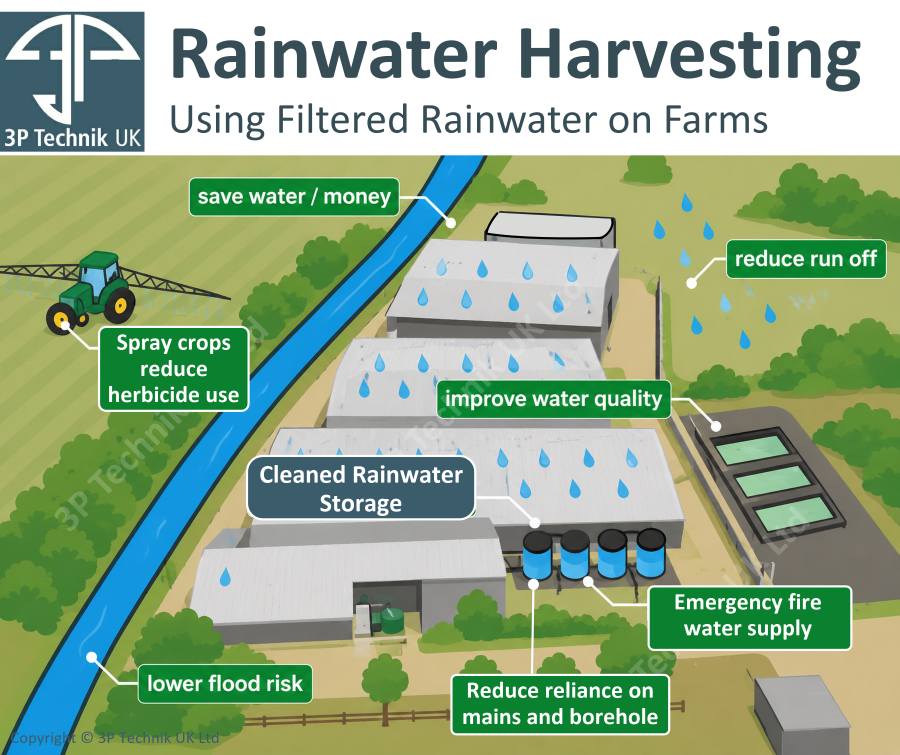
Rainwater harvesting can do a lot for a farm. It can help:
- reduce reliance on mains water and boreholes,
- make better use of rainfall falling on farm buildings (diverting rain out of the slurry system or preventing it from falling on foul yard areas),
- create greater resilience during dry periods,
- help to slow the flow during wet periods,
- reduce chemical use for crop spraying.
Rainwater harvesting makes productive use of large agricultural roof areas and provides a valuable source of water for suitable day-to-day uses. For farms looking to become more resilient to changing weather patterns and pressure on water supplies, storing rainfall makes increasing sense.
But there is another potential benefit that is beginning to attract more attention: Firefighting.
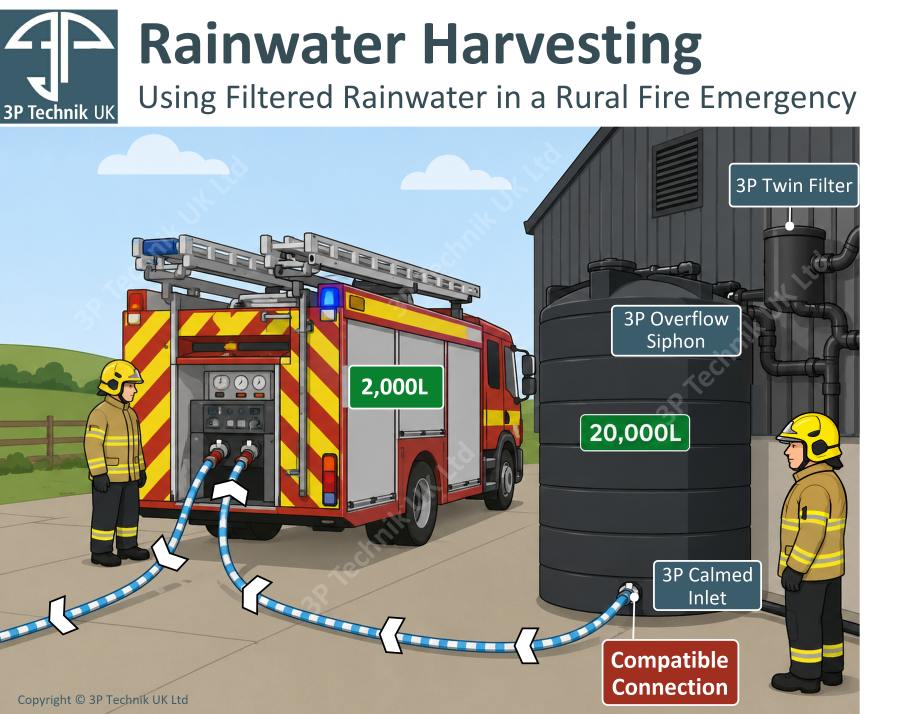
When a fire breaks out in a rural area, access to water can be a major challenge. Farms can be some distance from the nearest hydrant, while agricultural fires can develop rapidly and require significant volumes of water. A fire engine’s 2000-litre tank, depending on the hose flow rate and equipment used, can empty in just three to six minutes.
At the same time, many farms have one resource already on site: large roofs capable of collecting substantial amounts of rainwater.
With the right system, and the right planning, that stored water could potentially provide firefighters with an additional source of water in an emergency. However, a rainwater tank does not automatically become a firefighting water supply simply because it contains water. Fire and Rescue Services need to be able to find it, reach it and access it.
The growing work between the farming industry and Fire and Rescue Services suggests that rainwater harvesting could become another reason to invest in on-farm water storage.
Farmers store rainwater, but can firefighters use it?
Cambridgeshire Fire and Rescue Service has been working with farmers to identify and register rainwater harvesting tanks that could potentially provide water during an emergency.
The project highlights a simple but important point: having thousands of litres of water on a farm is not necessarily the same as having thousands of litres available to firefighters. There can be practical barriers.
- Can a fire engine safely reach the tank?
- Is there enough water available?
- Can the fire engine connect to the system?
- Does the fire service even know the water is there?
The NFU has also highlighted the issue of connection compatibility. Fire appliances and agricultural water supplies do not always use the same fittings. Farm bowsers commonly use 2-inch camlock connections, while fire appliances commonly use 70mm standard instantaneous couplings. Some Fire and Rescue Services are now introducing specialist adaptors to help access agricultural water supplies.
The “Five Questions” farmers should ask about every rainwater system
If farmers are going to consider firefighting as another benefit of rainwater harvesting, there are five important things to think about.
1. How much water is actually available?
The first question is obvious, but the answer is not always as simple as looking at the size of the tank.
A 50,000-litre tank does not necessarily mean there are 50,000 litres available to firefighters.
The water may be partly allocated to other farm uses. Levels may be lower after a prolonged dry spell. Or the tank may be close to empty at exactly the time a fire occurs.
If firefighting is being considered as an additional benefit of a rainwater harvesting system, farmers should think about the realistic volume of water likely to be available.
That does not necessarily mean reserving an entire tank solely for emergencies. For many farms, that would be impractical.
Instead, it means understanding what the system can realistically provide and communicating that information accurately if the water source is discussed with the local Fire and Rescue Service.
2. Can you rely on the system to collect and store water effectively?
The second consideration is the rainwater harvesting system itself.
Agricultural roofs can collect significant volumes of rainfall, but they also collect leaves, moss, dust, bird debris and other material.
A properly designed filtration and storage system helps ensure that the tank is collecting and retaining usable water efficiently.
At 3P Technik, the rainwater harvesting process focuses on three stages:
- First, filtration before storage. Rainwater passes through a two-step filter that removes debris before the water enters the tank. 3P Technik filters all exceed DEFRA grant requirements.
- Second, a calmed inlet. This introduces fresh oxygenated water into the bottom of the tank in a controlled way, helping to avoid disturbing sediment particles that have settled at the bottom.
- Third, an overflow siphon. This helps remove floating material (pollens etc) from the surface when the tank overflows.
Together, these cleaning stages help manage the water from the point it leaves the roof through to medium-term storage.
For a farm considering stored rainwater as part of its wider emergency resilience, the principle is straightforward:
A potential emergency water supply needs to be a system you can depend on – not simply a tank that occasionally happens to contain water.
3. Can the fire service get to it?
A large volume of stored water is of little use if a fire engine cannot reach it.
Farm layouts can change over time. Access tracks may become obstructed, gates may be locked or unsuitable for large vehicles, and ground conditions can make it difficult for heavy vehicles to approach a tank.
If stored rainwater is being considered as a potential emergency resource, access should be part of the farm planning.
Questions worth considering include:
- Can a fire engine safely reach the tank?
- Is the access route suitable for a large, heavy vehicle?
- Could parked machinery or other equipment block the route?
- Is the location clearly identifiable?
- Could firefighters find it quickly at night or in poor conditions?
These are not necessarily questions a rainwater harvesting supplier can answer alone. They are exactly the sort of practical issues that should be discussed with the local Fire and Rescue Service.
4. Can firefighters connect to the water?
This may be the biggest practical challenge.
Agricultural water systems and fire appliances do not always use compatible connections.
The NFU has highlighted the difference between common agricultural 2-inch camlock fittings, and the 70mm standard instantaneous couplings commonly used by fire appliances. Some services are developing specialist adaptors to overcome this problem.
However, there is no substitute for checking locally.
Farmers should not simply buy an adaptor online and assume it will work with every fire appliance.
Instead, if you want your stored water to be genuinely useful in an emergency, speak to your local Fire and Rescue Service about:
- the type of connection they use,
- whether they have suitable adaptors,
- whether the tank can be accessed directly, and
- what arrangement they would recommend.
That conversation could make the difference between a tank of water sitting nearby and a water source that can actually be used in an emergency.
5. Does the Fire and Rescue Service know it exists?
Finally, there is a simple question that is easy to overlook: If there is a fire, will firefighters know the water is there?
Cambridgeshire Fire and Rescue Service’s work with farmers demonstrates the potential value of identifying and recording private water supplies in advance.
If a service has a process for registering or recording available water sources, a rainwater harvesting tank may be able to form part of that wider operational picture.
Even where there is no formal registration scheme, discussing the system with the local service can help establish whether the stored water could realistically be used.
The key is to have the conversation before an emergency.
Summary: Another reason to harvest rainwater
Rainwater harvesting should not be viewed as a firefighting system first and foremost. For most farms, its primary benefits will remain the everyday ones: making use of rainfall, reducing demand on other water sources and improving long-term water resilience. The drought of Summer 2026 in the UK has demonstrated that firefighting could be another benefit.
Is your rainwater harvesting system emergency-ready?
If you are installing or reviewing a farm rainwater harvesting system, ask:
- How much water is realistically available?
- Can you rely on the system to collect and store it effectively?
- Can a fire appliance safely get to the water?
- Can firefighters connect to and access the supply?
- Does your local Fire and Rescue Service know it is there?
Rainwater harvesting is already an important tool for farm water resilience.
But as Fire and Rescue Services increasingly look at ways to access water in rural areas, it may offer something else too.
Another reason to collect the rain that falls on your farm. And another layer of resilience when every litre could matter.
Further Information
3P Technik offers a range of rainwater harvesting solutions for domestic, commercial and industrial applications.
Our filter systems help property owners, developers and organisations make better use of natural water resources while reducing reliance on mains water supplies.
By implementing rainwater harvesting systems, you can contribute to a more sustainable and resilient future while supporting responsible water management practices. Contact us for more information.