
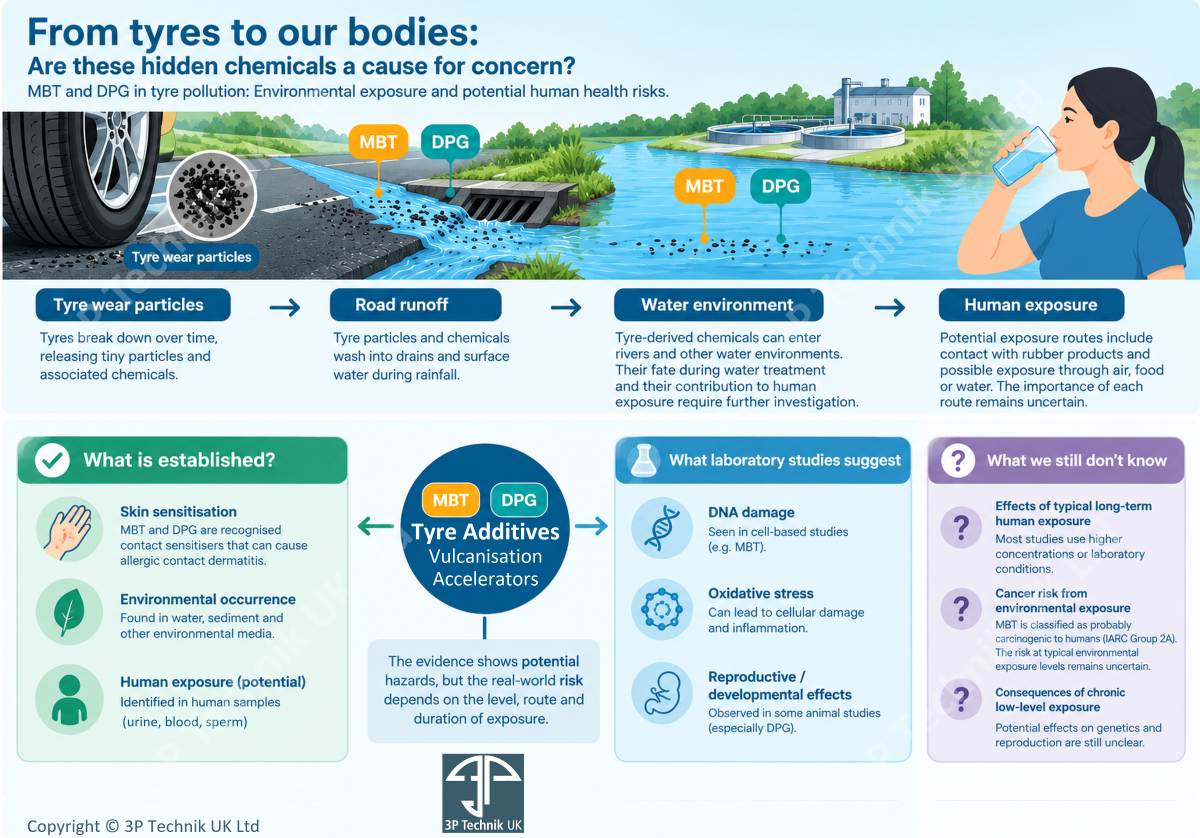
Two chemicals used in tyre manufacturing, 2-mercaptobenzothiazole (MBT) and 1,3-diphenylguanidine (DPG), are increasingly attracting attention as environmental pollutants. These tyre rubber accelerators can enter road runoff and aquatic environments through tyre wear, raising questions about potential human exposure and health effects.
This article by Master of Research (MRes) student at Cardiff University’s School of Biosciences, Tesni Hyett, explores what current research tells us about MBT and DPG, including evidence relating to skin sensitisation, genotoxicity, cancer and reproductive health. While laboratory and animal studies have identified potential hazards, important gaps remain in our understanding of the risks associated with everyday environmental exposure. Tesni examines the evidence, highlights what remains uncertain, and considers why further research into tyre-related pollution matters for both human health and the environment.
MBT and DPG in Tyre Pollution: Environmental Exposure and Potential Human Health Risks
A recent technical paper by Alys Bradshaw about MBT and DPG raised questions about how these common tyre additives may affect human health and, if any, human genetics and molecular biology.
For a more detailed overview of the chemicals themselves, their presence and fate in the natural environment and their potential ecological impact, please refer to Bradshaw’s paper: Tyre Wear Particles in Stormwater: Why MBT and DPG Chemical Contamination Matters.
2-Mercaptobenzothiazole (MBT) and 1,3-Diphenylguanidine (DPG) are both chemical accelerators, added during the manufacturing of tyres to improve the performance and durability of rubber in the tyre produced.
Having previously looked at the fate of 6-PPD, another tyre additive pollutant, I was interested in looking at the fate of these compounds in terms of biomedicine and their impacts on human health and genetics.
As expected after my research into the literature surrounding 6PPD and human health, there is again a substantial research gap into the impact of environmentally relevant levels of exposure to MBT and DPG on the health and genetics of humans.
Furthermore, much of the research presented and discussed is based upon experiments in controlled conditions in experimental animal models. Therefore, a risk that the chemicals cause biological harm is well established, but questions remain as to whether MBT and DPG, in their concentrations present in hydrological systems, cause any risk to humans.
Brief Introduction to MBT and DPG chemicals
MBT (2-Mercaptobenzothiazole)
MBT has been a primary vulcanisation accelerator in tyre production since 1925. An organosulfur compound, MBT is commonly found in its dissolved state in the natural environment. Japanese studies detected a presence of MBT in human samples as early as 19771. A 2015 German study detected MBT in human urine, including in one sample from an individual unexposed to MBT, and in samples from occupationally exposed workers2. MBT in its dissolved state is difficult to detect and isolate, meaning its identification in human samples is a particular challenge.
DPG (1,3-Diphenylguanidine)
DPG, an organic compound, is a secondary vulcanisation accelerator. In the natural environment, DPG primarily becomes particle-bound.
A recent study in South China investigated the occurrence of 23 tyre additives (and their transformation products) in urban water systems3. The study identified DPG as the tyre-wear compound at the highest maximum concentration in surface runoff (58790 ng/L). This same study estimated that humans consume between 2.63 × 10⁻⁸-3.16 × 10⁻⁵ mg/(kg d) of tyre additive compounds daily through drinking water.
Due to their individual chemical profiles, MBT and DPG chemical accelerators naturally interact with the natural environment in distinct ways. Therefore, they also behave differently when in contact with, or are absorbed by, animal or human bodies.
Skin
Both MBT and DPG have been linked to contact sensitisation and inflammation (dermatitis), due to allergic reactions and hypersensitivity.
MBT and DPG are used very widely in rubber products. Previous studies have detected problems arising from its presence in bikinis, synthetic rubber protective gloves (often used in medical settings), and condoms4,5.
DPG in gloves used in healthcare and for medical examination is mentioned widely in the literature6. Gloves containing DPG only require short-term contact with the skin to expose the wearer to DPG. The study also found that the use of ethanol-based hand washes prior to wearing the DPG-containing gloves increased the amount of DPG subsequently detected on the wearer’s hands7.
Both chemicals are commonly relevant in cases of dermatitis worldwide8. Although not perhaps seen as a particularly serious threat to human health, skin irritation and inflammation may raise concerns about the potential consequences of inhalation or ingestion of MBT or DPG.
Carcinogenicity
Studies using murine models determined that DPG was not a carcinogen. However, there is insufficient evidence to determine if DPG is carcinogenic in humans.
In contrast, MBT has been classified by the International Agency for Research on Cancer (IARC) as a Group 2A carcinogen, probably carcinogenic to humans (in 2018). The IARC based this classification on limited evidence of carcinogenicity in humans but with sufficient evidence of carcinogenicity in experimental animals. But IARC has recommended that further research be carried out into MBT and the cancers of the large intestine, bladder and multiple myeloma to investigate any potential causal relationship. Reports have shown an increased incidence of these cancers among workers exposed to MBT, leading to the Group 2A classification (although these workers were also often exposed to other potentially carcinogenic chemicals).
There may be a relationship between exposure to MBT and cancer that has yet to be established, potentially providing further evidence for its role as a carcinogen.
Bladder Cancer is the focus of the majority of studies investigating the impact of MBT on human health. There is evidence suggesting an association between occupational MBT exposure and bladder cancer. For example, a 2022 paper provides cell-based observations of MBT binding to molecules to promote transcription of genes linked to cancer metastasis (the spread of cancer cells)9. A study revealed more about the potential mechanistic pathway of MBT in bladder cancer, potentially promoting carcinogenesis through metabolism of reactive oxygen species (ROS) and cytochrome molecules10. Amongst other chemicals studied, MBT was determined to be a ‘particularly potent DNA damaging agent’.
Genotoxicity
The evidence for genotoxicity is currently mixed. Earlier studies on MBT found limited or weak evidence for genotoxic effects, while evidence for DPG remains limited. An initial general consideration may well conclude that MBT and DPG are not genotoxic.1 However, a recent paper in 2025 by Hyman et al. contradicts the conclusion that there is no risk of genotoxicity, suggesting a potential for genotoxicity.
MBT and Genotoxicity
In 2025, Hyman et al. found MBT and other tyre additives (such as 6PPD) induced DNA damage in a human lung cell type, showing a concentration-dependent response 11. Interestingly, this study identified that intracellular Glutathione (GSH) levels were depleted in response to exposure to tyre additives. GSH can prevent damage to certain cellular components, so its depletion may allow DNA damage to take place. In fact, this study added NAC, a precursor to GSH, to the cells when exposed to tyre additives (6PPD specifically), which seemed to have a mitigating effect on the observed DNA damage. It must be noted that the concentrations of tyre additives used in this study are higher than what human lung cells are likely exposed to in real-world conditions.
A 2023 paper has also shown the involvement of MBT and other contact sensitisers in the activation and maturation of dendritic cells (involved in the human immune response) through mRNA regulation12.
DPG and Genotoxicity
The evidence available to this review is insufficient to draw a firm conclusion about the carcinogenicity of DPG (on its own) in humans. However, free chlorine is commonly added during drinking water treatment before distribution, as a residual disinfectant. The product formed when DPG reacts with free chlorine is potentially genotoxic, with evidence of chlorinated DPG inducing DNA damage in HepG2 cells (based on genetic testing and cellular assays)13.
It is important to note here that this in vitro evidence does not establish that drinking chlorinated water with DPG causes DNA damage in humans.
Reproduction and Developmental processes
MBT does not appear to directly impact reproductive or developmental processes (study in rats). However, issues were observed to arise in association with maternal toxicity. 1
In contrast, DPG has been associated with multiple effects on reproductive processes across various model animals (rats, mice, and hamsters). Both the male and female sexes were affected, with factors such as decreased sperm count, increased menstrual cycle length, fertility issues, and reduced implantation success observed across the animals studied. Following parental exposure to DPG, the offspring of studied rats had decreased mean body weights during postpartum growth.14, 15
Interestingly, a 2023 study detected MBT in human sperm. If the detection of MBT in sperm has only occurred in recent years, there may still be a lot to learn about the impact of MBT in human reproduction16.
On a further worrying note, a recent study has detected DPG, amongst other additives, in maternal and cord blood at the time of baby’s delivery17. Detection of DPG in maternal blood raises important questions when assessing potential risks for foetal development and exposure.
Concluding remarks
As I embark on my Master of Research at Cardiff University School of Biosciences, I see the whole world of research ahead of me.
A concept I have repeatedly come across in my studies is the ‘One Health’ approach in relation to disease control. The WHO defines this as “an integrated, unifying approach that aims to sustainably balance and optimise the health of people, animals and ecosystems”. This integrated approach is based on the belief that the health of people, animals, ecosystems and the wider environment are ‘closely linked and interdependent’ (WHO).
Having the opportunity to research and write articles on behalf of 3P Technik UK has reinforced my opinion that interdisciplinary science and research is essential for the future of humans and our planet Earth along with all that belongs to her.
Perhaps this ‘One Health’ approach should be adapted across disciplines.
There is an opportunity and a need for future research in respect of MBT and DPG, particularly in respect of their potential genotoxicity and carcinogenicity in humans.
However, based on the research presented in this brief article (by no means a complete overview of all current and past research on these chemicals!), the question must be asked as to why industries happily add them to their products, and if there is a real NEED for MBT and DPG to be a part of our daily lives.
Author: Tesni Hyett, Master of Research (MRes) student at Cardiff University’s School of Biosciences
Treatment Solutions for Tyre Wear Particles and Derived Pollutants
3P Technik’s HydroSystem allows for sedimentation to take place in the hydrodynamic separator, where any sediments containing DPG will settle and can be collected and removed as usual via the silt trap chamber access pipe. The water is then passed up through a filter element which will capture finer particles and potentially remove dissolved MBT from the water. The DPG is then permanently removed when exchanging the filter, at the required intervals. This HydroSystem treatment system allows for an output of clean water, which will improve the environment and pose fewer risks to aquatic environments and the organisms that live in them.
3P Technik’s technical team can provide project-specific advice and support. Please contact us to discuss your requirements.
Reference list:
- 2-Mercaptobenzothiazole (Compound). PubChem https://pubchem.ncbi.nlm.nih.gov/compound/2-Mercaptobenzothiazole
- Gries, W., Küpper, K., Leng, G. 2015. Rapid and sensitive LC-MS-MS determination of 2-mercaptobenzothiazole, a rubber additive, in human urine. Anal Bioanal Chem 407(12), pp. 3417-2. Doi: 0.1007/s00216-015-8533-5
- Zhang, H-Y., Huang, Z., Liu, Y-H., He, L-Y., Liu, Y-S., Zhao, J-L., Ying, G-G. 2023. Occurrence and risks of 23 tire additives and their transformation products in an urban water system. Environmental International 107715(171). Doi: https://doi.org/10.1016/j.envint.2022.107715
- Dejonckheere, G., Herman, A., Baeck, M. 2019. Allergic contact dermatitis caused by synthetic rubber gloves in healthcare workers: Sensitization to 1,3-diphenylguanidine is common. Contact Dermatitis 81(3), pp. 167-173. Doi: 10.1111/cod.13269
- Figueiredo, C, Cuhna, F., Gonçalo, M. 2024. Bikini Contact Dermatitis Due to Mercaptobenzothiazole. AMP 37(5). Doi: https://doi.org/10.20344/amp.20492
- Hansen, A., Buse, A-B., Wilke, A., Skudlik, C., John, S. M., Brans, R. 2021. Sensitization to 1,3-diphenylguanidine: An underestimated problem in physicians and nurses using surgical gloves? Contact Dermatitis 84(3), pp 207-208. Doi: https://doi.org/10.1111/cod.13713
- Hamnerius, N., Pontén, A., Björk, J., Persson, C., Bergendorff, O. 2019. Skin exposure to the rubber accelerator diphenylguanidine in medical gloves – An experimental study. Contact Dermatitis 81(1), pp 9-16. Doi: https://doi.org/10.1111/cod.13238
- Isufi, D., Larsen, C. K., Jensen, M. B., Karimian, K., Zachariae, C., Schwensen, J. F. B., Alinaghi, F., Johansen, J. D. 2025. Prevalence of Contact Allergy to Rubber Accelerators From the European Baseline Series in Dermatitis Patients: A Systematic Review and Meta-Analysis. Contact Dermatitis 93(6), pp. 439-463. Doi: https://doi.org/10.1111/cod.70024
- Zhang, J., Cui, S., Shen, L., Gao, Y., Liu, W., Zhang, C., Zhuang, S. 2022. Promotion of Bladder Cancer Cell Metastasis by 2‑Mercaptobenzothiazole via Its Activation of Aryl Hydrocarbon Receptor Transcription: Molecular Dynamics Simulations, Cell-Based Assays, and Machine Learning-Driven Prediction. Environmental Science & Technology 56(18), pp 13254-13263. Doi: https://doi.org/10.1021/acs.est.2c05178
- Qi, Y., Toyooka, T., Horiguchi, H., Koda, S., Wang, R-S. 2022. 2-mercaptobenzothiazole generates γ-H2AX via CYP2E1-dependent production of reactive oxygen species in urothelial cells. Journal of Biochemical and Molecular Toxicology 36(6). Doi: https://doi.org/10.1002/jbt.23043
- Hyman, S. et al. 2025. Oxidative stress generated DNA damage by 6PPD and other tyre additives in A549 human lung epithelial cells. Scientific Reports 15(35615). Doi: https://doi.org/10.1038/s41598-025-19232-y
- Galbiati, V., Lefevre, M-A., Maddalon, A., Vocanson, M., Iulini, M., Marinovich, M., Corsini, E. 2023. Role of miR-24-3p and miR-146a-5p in dendritic cells’ maturation process induced by contact sensitizers. Archives of Toxicology 97, pp 2183-2191. Doi: https://doi.org/10.1007/s00204-023-03542-z
- Santos, M. M. D., Cheriaux, C., Jia, S., Thomas, M., Gallard, H., Croué, J-P., Carato, P., Snyder, S. A. 2022. Genotoxic effects of chlorinated disinfection by-products of 1,3-diphenylguanidine (DPG): Cell-based in-vitro testing and formation potential during water disinfection. Journal of Hazardous Materials 436(129114). Doi: https://doi.org/10.1016/j.jhazmat.2022.129114
- Diphenylguanidine (Compound). PubChem. https://pubchem.ncbi.nlm.nih.gov/compound/7594
- Bempong, M. A., Hall, E. V. 1983. Reproductive toxicology of 1,3-diphenylguanidine: analysis of induced sperm abnormalities in mice and hamsters and reproductive consequences in mice. Journal of Toxicology Environmental Health 11(4-6), pp 869-78. Doi: 10.1080/15287398309530390
- Sánchez-Resino, E. et al. 2023. Exploring the Occurrence of Organic Contaminants in Human Semen through an Innovative LC-HRMS-Based Methodology Suitable for Target and Nontarget Analysis. Environmental Science Technology 57(48), pp. 19236-19252. Doi: https://doi.org/10.1021/acs.est.3c04347
- Tang, S., Sun, X., Qiao, X., Cui, W., Yu, F., Zeng, X., Cavaci, A., Chen, D. 2022. Prenatal Exposure to Emerging Plasticizers and Synthetic Antioxidants and Their Potency to Cross Human Placenta. Environmental Science & Technology 56(12), pp 8507-8517. Doi: https://doi.org/10.1021/acs.est.2c01141