
This article compares in detail the Welsh and English SuDS Standards for Sustainable Drainage Systems. Note this review is based on information available in March 2026.
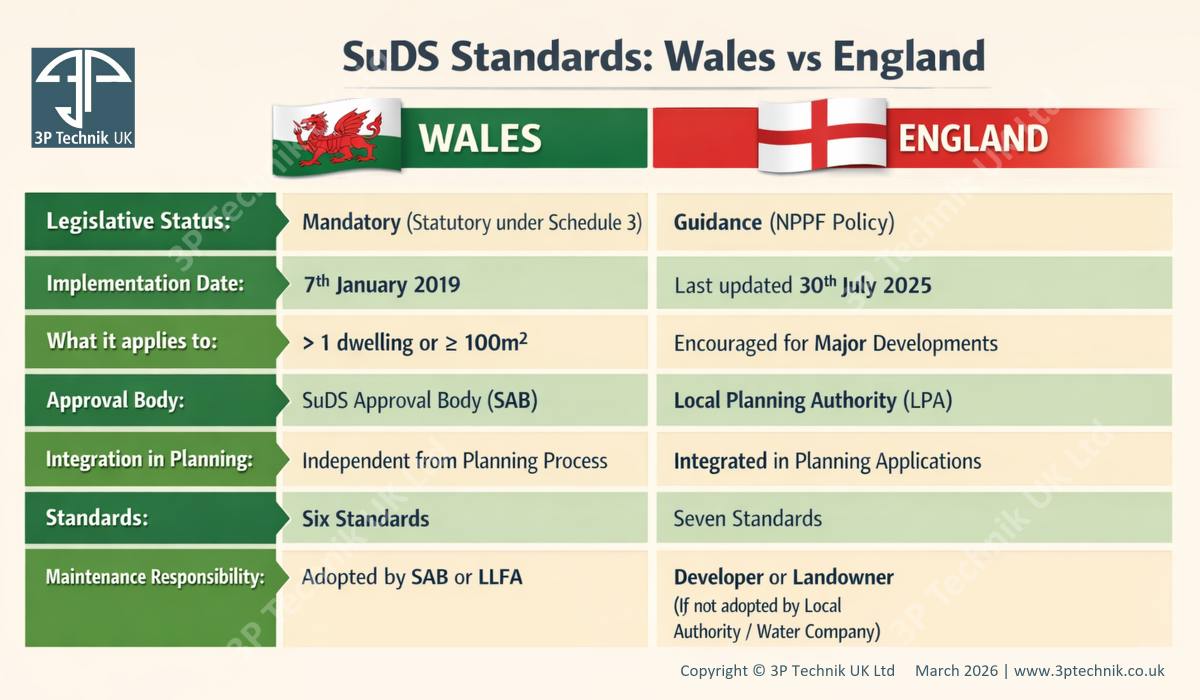
SuDS Standards Comparison Wales v England Summary Table
SuDS (Sustainable Drainage Systems) are implemented to manage the surface water runoff from a site in a sustainable way that mimics the natural drainage processes. While both Wales and England operate under the Flood and Water Management Act 2010, their SuDS regulatory implementation standards differ significantly.
The SuDS Standards ensure that drainage systems work effectively at protecting and enhancing the natural or man-made environment by focusing on water quantity, water quality, amenity and biodiversity.
1.0 Legislative framework
The Flood and Water Management Act 2010 is the primary legislation for both Wales and England. Schedule 3 of the legislation describes how SuDS implementation should look like and the establishment of a SAB (SuDS Approval Body), which is then responsible for the approval and adoption of proposed SuDS.
- In Wales, Schedule 3 was enacted in January 2019, making SuDS Standards a legal requirement.
- In England, Schedule 3 is not yet fully enacted which makes it a policy compliance requirement for developers.
Unlike Wales, England’s SuDS Standards remain advisory rather than statutory and therefore not legally binding. DEFRA had planned for SuDS guidance to become mandatory in 2024; however, they are still not fully in place legally in 2026.
2.0 Structure of the SuDS Standards
The Welsh statutory SuDS Standards include six mandatory criteria:
- S1 Surface Water Runoff Destination
- S2 Surface Water Runoff Hydraulic Control
- S3 Water Quality
- S4 Amenity
- S5 Biodiversity
- S6 Design of drainage for construction, operation and maintenance
In England, the guidance published by DEFRA sets out seven non-statutory standards:
- S1 Runoff Destinations
- S2 Management of everyday rainfall (interception)
- S3 Management of extreme rainfall and flooding
- S4 Water Quality
- S5 Amenity
- S6 Biodiversity
- S7 Design of drainage for construction, operation, maintenance, decommissioning and structural integrity
3.0 Implementation and Approval Process
3.1 Wales
In Wales, before any construction can begin developers must obtain approval from the SAB, which operates as a separate board within the local authority. This board is independent from the planning application process. It is recommended to apply for SAB approval at the same time as planning and at the earliest time possible. The SAB are to work alongside the LLFA (Lead Local Flood Authority) and adopt and maintain the SuDS if all standards are met and serve more than one property. If the SAB does not adopt the SuDS, or if it serves one property, the landowner or developer is responsible for maintenance and upkeep. Applicants must demonstrate that SuDS Standards will be complied with on their site to gain SAB approval. SuDS Standards must be implemented for any new development that consists of more than one dwelling or where construction work area is greater than or equal to 100m2. A property is exempt from SAB approval if it consists of a single dwelling with a construction area of less than 100m2. SuDS Standards also apply to redevelopment projects that meet those criteria in Wales.
3.2 England
There is no SAB equivalent in England, instead the Local Planning Authority (LPA) oversees the SuDS approval process. Use of the DEFRA authored guidance is encouraged for major developments (10 or more dwellings), “unless there is clear evidence that this would be inappropriate” (National Planning Policy Framework 181.c.).
The specific meaning of “clear evidence” is uncertain and not defined in the NPPF report, but could include:
- High pollution risk to surface water or ground water from the land use. In this case a self-containing storage or treatment facility would be needed instead (English SuDS Standard 4.8)
- High natural groundwater levels, meaning an infiltration-based SuDS technique (e.g. soakaways, infiltration basins/ trenches, permeable pavement) cannot be installed as the water level would rise too much with incoming rain or storm events, resulting in an increase in local flooding
- Lack of suitable discharge points to surface water, groundwater or a water body, and so a different drainage approach will need to be implemented.
- Size constraints of the site itself due to existing buildings or features can affect the feasibility of applying a SuDS feature.
- If long-term ownership or maintenance responsibilities are unclear/ unknown, SuDS features may be deemed inappropriate.
SuDS are regulated by the National Planning Policy Framework through Local Planning Authorities where they set out the seven non-statutory SuDS Standards. If the SuDS feature is not adopted by an organisation such as a local authority or water company, the default responsibility for the SuDS are the landowners, who would then be responsible for the maintenance of the SuDS for its design life.
4.0 Comparison of Welsh and English SuDS Standards
Table 1: Comparison of the Welsh and English SuDS Standards
| Wales | England | |
|---|---|---|
| Legislative Status | Mandatory (Statutory under Schedule 3) | Guidance (NPPF Policy) |
| Implementation date | 7th January 2019 | Last updated 30th July 2025 |
| What it applies to | > 1 dwelling or where construction work is ≥ 100m2 | Encouraged for major developments |
| Approval Body | SuDS Approval Body (SAB) | Local Planning Authority (LPA) |
| Integration in planning process | Independent from planning process, but should be considered at the same time | Integrated in planning applications |
| Standards | Six standards | Seven standards |
| Maintenance Responsibility | Adopted by SAB or LLFA | Developer or Landowner if not adopted by local authority or water company |
For both Wales and England, the first standard (Runoff Destination) is classified as the Hierarchy Standard, while subsequent standards are termed Fixed Standards (S2-S6 in Wales or S2-S7 in England). These Fixed Standards provide the minimum design criteria that drainage systems should be compliant with.
4.1 Runoff Hierarchy (S1)
Both Wales and England apply a hierarchy approach which has as the highest priority for surface water runoff management the reuse of water as close to its source as possible, suggesting rainwater harvesting methods to achieve this. The priority levels are as follows:
- Collected for reuse
- Infiltration to the ground
- Discharge to a surface water body
- Discharge to a surface water sewer, highway drain or another drainage system
- Discharge to a combined sewer
Both see that priority level 1 is preferred and has the highest priority to achieve as much as possible. The downgrading to a lower priority should only be considered when the maximum volume of runoff has been consumed or managed in the higher priority levels first. The runoff from a development should not increase the likelihood of flooding elsewhere and the priority level destinations should be planned out accordingly.
Due to the Welsh standards being statutory, downgrading in priority destinations requires strong evidence, for example including infiltration tests, site condition or contamination risk surveys of the site to prove justification.
There is however a set of three exemption conditions allowing RWH to be completely ignored in all Welsh based projects despite it being mandatory. England allows some flexibility and can downgrade if constraints exist, which makes it easier to lower compliance to the hierarchy.
Rainwater harvesting systems involve the collection of rainwater from rooftops into water tanks or water butts that are fed through guttering and downpipes. They are used to comply with priority level 1 but likely not adequate to handle the entirety of the site’s drainage; therefore, priority level 2 and lower must be considered for most sites. The rainwater collected can be reused on site for the irrigation of gardens, laundry, car washes or flushing toilets in domestic houses or commercial premises. It is rare that there would be no requirement for non-potable water in any building development. Also see our article “How Rainwater Harvesting Strengthens SuDS“.
4.2 Hydraulic Control (S2 Wales, S2-S3 England)
Wales combines flow rate and volume control into one standard (S2), while England separates them into “everyday” (S2) and “extreme” (S3) rainfall events. These aim to manage surface water runoff against the future effects of climate change and urban creep, while also managing surface water runoff in a way that mimics the natural process of drainage. This should be done by capturing rainfall (under 5mm in England) and preventing surface water runoff.
4.3 Water Quality (S3 Wales, S4 England)
Both require the SuDS feature to clean pollutants found in the surface runoff water. Wales statutory standards aim to ensure pollutant chemicals do not reach groundwater sources. England’s guidance specifies a fuller treatment requirement for higher risk land uses.
Different SuDS components and how they should be designed, implemented and maintained are laid out in the SuDS Manual (CIRIA, 2015), specifically PART D- Technical detail. Chapter 14 (Proprietary Treatment Systems) and Chapter 26 (Water quality management design methods) are of use when selecting the appropriate devices in accordance with runoff and pollution loads.
Chapter 26 of the SUDS manual provides for the use of mitigation indices (MI) that SuDS components should reach depending on the local land use (categorised pollution hazards as low-medium-high). The surrounding land use determines the type of pollutants, and the pollutant loads present within surface water runoff. MI range on a scale of 0-1, where 0 presents no pollution hazards and 1 presents a high pollution hazard. The pollution hazards are divided into TSS (Total Suspended Solids), metals and hydrocarbons- these are typically found in surface water runoff and must be removed for clean, safe water to be discharged into receiving waters. These MI can be seen in Table 26.2 (Pollution hazard indices for different land use classifications) within the SuDS Manual (page 566). To ensure the correct amount of pollutant removal is taking place at any one site, the MI for TSS, metals and hydrocarbons must be met, ensuring their removal from surface water runoff. In most cases, a treatment train is advocated which includes multiple SuDS components providing different stages of treatment on the runoff. This system ensures that the correct pollutants are being targeted at the correct rate of removal depending on the PSD (Particle Size Distribution) and pollutant load of the surface water runoff. Long-term local resilience can be built against pollutant risks posed to animals, humans and their environments and future climate change impacts.
Proprietary treatment systems (Chapter 14, CIRIA, 2025) are systems and products that have been manufactured to target the removal of specific pollutants and are often used in treatment trains to protect downstream SuDS. The main treatment processes that may occur within a proprietary treatment system include, settlement, vortex separation, filtration, adsorption and physical removal of pollutants.
3P Technik UK are experts in stormwater treatment and have designed many different proprietary treatment systems that can be easily implemented for efficient pollutant removal from surface water runoff. The 3P HydroShark is a hydrodynamic particle separator that uses a radial- vortex flow pattern to remove settleable solids. The remobilisation of settled solids is impossible even during heavy rainfall events and the sludge chamber (where sediments and pollutants have settled) can easily be emptied to ensure performance levels are high. The 3P HydroSystem is another subsurface proprietary treatment system which can treat surface water runoff through sedimentation, filtration, adsorption and ion exchange. These four stages of treatment are designed for high polluted areas and high trafficked areas. Many different sizes of the 3P HydroShark and HydroSystem exist which can be deployed to treat varying traffic and roof runoff flows. Both 3P products are certified by various organisations such as the DIBt, NJDEP and British Water and therefore guarantee pollutants are removed up to certain standards (Table 26.2 set out in the SuDS Manual).
4.4 Amenity and Biodiversity (S4-S5 Wales, S5-S6 England)
Both nations promote multifunctionality SuDS features that enhance amenity for the public and support biodiversity for flora and fauna.
4.5 Design, Operation and Maintenance (S6 Wales, S7 England)
Both sets of standards require design for long-lasting and effective performance features with ease of maintenance and resilience against climate change. England’s guidance includes a more detailed requirement for monitoring, access for inspections, energy use and structural safety, while failure to meet Standard 6 in Wales can lead to enforcement action.
5.0 Conclusion
Both Wales and England share the same basic principles for SuDS which aim to improve water quality, reduce water quantity and therefore flood risk and support biodiversity and amenity, but their legislative implementation differs. Wales’s statutory SuDS Standards provide legal enforcement, which ensures more consistency in standards, accountability for management and adoption protocols. The added time for approvals from separate bodies within the local authorities could pose difficulties in planning and construction, but experience to date has been positive overall. While England’s guidance approach relies on local interpretation and offers flexibility, this could however, lead to inconsistent implementation and lessened maintenance standards in particular due to uncertainties.
As England moves towards enacting Schedule 3 which aligns both systems, a new national framework for sustainable drainage could be set – ensuring better protection against flooding and more concise surface water runoff management for the UK.
A review of and better standards for water quality treatment is urgently required across the whole of the UK.
Author: Alys Bradshaw, 3P Technik UK Ltd.
Date: March 2026
SuDS Design
At 3P Technik we are always happy to review and discuss rainwater harvesting products and water quality treatment designs. Our suite of devices can be used either on their own or in a treatment train with green infrastructure. Contact us with your requirements.
References
- CIRIA, DEFRA, and NRW. 2015. The SuDS Manual.
- DEFRA. 2025. National standards for sustainable drainage systems (SuDS). https://www.gov.uk/government/publications/national-standards-for-sustainable-drainage-systems/national-standards-for-sustainable-drainage-systems-suds
- Flood and Water Management Act 2010, Schedule 3. https://www.legislation.gov.uk/ukpga/2010/29/schedule/3
- Ministry of Housing, Communities and Local Government. 2024. National Planning Policy Framework. https://assets.publishing.service.gov.uk/media/67aafe8f3b41f783cca46251/NPPF_December_2024.pdf
- The Welsh Government. 2018. Statutory standards for sustainable drainage systems- designing, construction, operating and maintaining surface water drainage systems. https://www.gov.wales/sites/default/files/publications/2019-06/statutory-national-standards-for-sustainable-drainage-systems.pdf